

Last Updated: October 23, 2026
Quick Summary
Live-edge furniture preserves the tree's natural boundary and irregular organic edge rather than cutting it away, distinguishing authentic handcrafted pieces from mass-produced versions that often use standardized profiles or artificial edges. Authentic live-edge furniture requires individual assessment of each slab, hand-finishing by skilled artisans, and proper wood drying over months or years, while mass-produced pieces use accelerated kiln-drying and standardized construction methods.
- Authentic live-edge dining tables typically cost $2,500 or more, reflecting skilled labor and proper materials, while mass-produced versions range from $800 to $1,800.
- Handcrafted pieces use solid wood joinery like mortise and tenon joints, while mass-produced furniture relies on dowels, pocket holes, or metal fasteners that fail as wood shifts.
- Authentic live-edge furniture can be refinished and improved with age, while mass-produced pieces often cannot be effectively restored and depreciate like manufactured goods.
- Every authentic live-edge piece is genuinely unique with unreplicable wood grain, knots, and edge contours, while mass-produced pieces create controlled variation across dozens of identical copies.
Table of Contents
- What Live-Edge Furniture Is and How It's Made
- Key Differences Between Authentic and Mass-Produced Live-Edge Furniture
- How to Identify Quality Live-Edge Furniture: An Authenticity Checklist
- Live-Edge Table Wood Species and Their Durability
- Live-Edge Table Finishes and Protection Methods
- Live-Edge Table Maintenance and Long-Term Care
- Cost Comparison and Long-Term Value
- Frequently Asked Questions
What Live-Edge Furniture Is and How It's Made
Live-edge furniture represents a fundamental departure from mass-produced design. The defining characteristic is that live-edge furniture preserves the tree's natural boundary, the irregular, organic edge where bark once grew, rather than cutting it away during manufacturing. This single choice shapes everything about the piece: its appearance, durability, cost, and the craftsmanship required to create it.
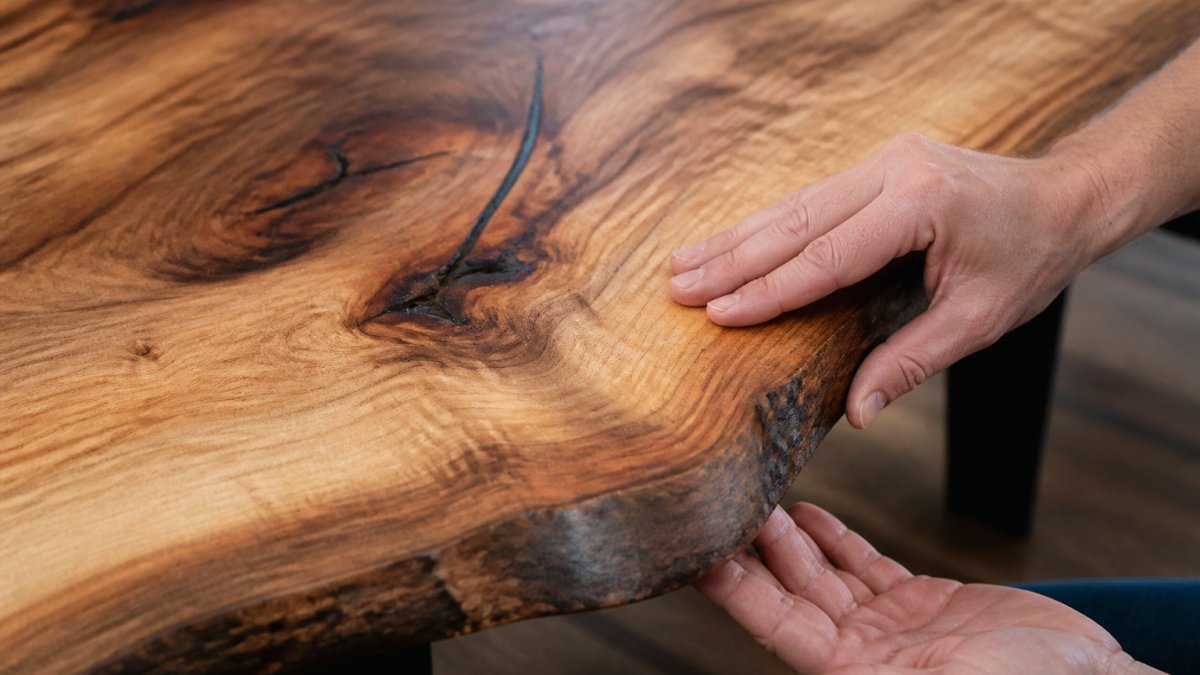
When a tree is felled and milled into slabs, the edges contain the growth rings closest to the bark. Authentic live-edge pieces keep those edges intact. The result is a tabletop or surface where one or more sides follow the tree's original perimeter, complete with natural curves, slight irregularities, and the authentic character that no factory tool can replicate.
The Natural Edge: How Slabs Retain the Tree's Boundary
The live edge is preserved through a deliberate choice in the milling and finishing process. After a tree is cut and the log is slab-sawn, the rough-cut slab retains its natural edges. Artisan woodworkers then hand-finish these edges, sanding, smoothing, and sealing them, while maintaining the organic contour.
This is where authentic craftsmanship diverges sharply from mass production. Handcrafted live-edge pieces require individual assessment of each slab. Every edge is unique, so finishing techniques must be adapted to the specific wood species, grain direction, and edge character.
Mass-produced live-edge furniture, by contrast, often uses standardized edge profiles applied to multiple pieces. Some manufacturers even apply artificial edges, resin or stain designed to simulate a live edge on pieces that started with straight, machine-cut sides.
Authentic Handcrafted vs. Mass-Produced Construction
The construction method determines not just aesthetics but also how the piece will perform over years of use. Authentic handcrafted live-edge furniture typically begins with sustainably sourced or reclaimed hardwood slabs that are properly dried, a process that can take months or even years depending on the wood species and thickness. This slow drying prevents the catastrophic cracking and warping that occurs when wood loses moisture too quickly.
Mass-produced pieces, especially imported furniture, often use accelerated kiln-drying to speed production. While faster, this method can leave internal stress in the wood that manifests as cracks and warping months or years after purchase.
Key Differences Between Authentic and Mass-Produced Live-Edge Furniture
The gap between authentic and mass-produced live-edge pieces extends far beyond surface appearance. Understanding these differences is essential for making an informed purchase that will last decades rather than years.
Natural Variation and One-of-a-Kind Character
Every authentic live-edge piece is genuinely unique. The wood grain, knots, color shifts, and edge contour cannot be replicated. This variability is the signature of real wood and real craftsmanship. When you purchase a handcrafted live-edge dining table from Mt. Modern, you're acquiring a specific object, not one of hundreds of identical copies.

Mass-produced live-edge furniture attempts to create the appearance of uniqueness through standardized variation. Manufacturers might produce 50 or 100 tables from the same wood species and finish, creating the illusion of one-of-a-kind character while maintaining cost efficiency.
This distinction matters for two reasons. First, if you value authenticity and originality, mass-produced pieces, however well-designed, deliver a simulation rather than the real thing. Second, genuine one-of-a-kind pieces often appreciate in value as heirloom furniture, while standardized reproductions depreciate like most manufactured goods.
Craftsmanship and Artisan Involvement
Handcrafted live-edge furniture requires skilled woodworkers who understand wood behavior, grain direction, joinery, and finishing. These artisans make decisions during production based on the specific characteristics of each slab. If a knot or crack appears during finishing, they adapt their approach rather than discarding the piece. This problem-solving and attention to detail cannot be automated.
Mass production, by design, minimizes artisan involvement. Machines cut, sand, and finish according to preset parameters. When variation occurs, pieces are often rejected rather than adapted. The result is consistency and lower cost, but it also means no individual craftsperson has invested skill and judgment into your specific table.
At Mt. Modern, each piece is evaluated individually, and finishing decisions are made by experienced hands, not factory settings.
How to Identify Quality Live-Edge Furniture: An Authenticity Checklist
Distinguishing authentic live-edge furniture from mass-produced imitations requires knowing what to inspect. Use this checklist when evaluating any live-edge piece before purchase.
| Authenticity Factor | What to Look For | Red Flag |
|---|---|---|
| Edge Profile | Irregular, organic curves that vary along the length | Uniform, perfectly smooth edge applied to all pieces |
| Wood Grain | Visible, natural grain patterns that shift with light | Uniform grain appearance across multiple pieces |
| Knots and Cracks | Present and integrated into the design; sealed but visible | Absence of natural features; too-perfect surface |
| Joinery | Solid wood joints (mortise/tenon, dovetails); no visible fasteners | Metal fasteners, dowels, or pocket holes visible |
| Finish | Hand-applied, with slight variation; protective coating visible | Machine-applied, perfectly uniform finish |
| Weight | Heavy; solid wood throughout | Lighter than expected; possible veneer or composite core |
| Documentation | Artisan name or maker information; warranty details | Generic product code; vague manufacturing details |
| Price | Reflects labor, materials, and time; typically $2,500 or more for dining tables | Suspiciously low price for claimed handcrafted status |
Beyond the checklist, ask direct questions. Where was the wood sourced? How long was it dried? Who finished the piece? If the seller cannot answer these questions or provides vague responses, the piece is likely mass-produced regardless of its appearance.
Live-Edge Table Wood Species and Their Durability
The wood species determines how the table will perform over time. Different hardwoods have distinct grain patterns, color characteristics, and durability profiles. Understanding these differences helps you choose a piece that will function well in your specific environment.
Parota wood, featured in Mt. Modern's collections, is a tropical hardwood known for dramatic grain, warm tones, and excellent durability. It resists warping and splitting better than softer woods, making it ideal for dining tables that will experience temperature and humidity fluctuations.
Acacia, used in our Nature's Edge Cocktail Table, offers a lighter aesthetic with good durability for smaller pieces.

When evaluating durability, consider the wood's hardness rating and how it responds to moisture changes. Denser hardwoods move less as humidity fluctuates, reducing the risk of warping and joint failure.
Natural Parota 95″ Live-Edge Dining Table →
Live-Edge Table Finishes and Protection Methods
The finish protects the wood and determines how the table will age. Authentic live-edge furniture uses finishes that enhance natural wood character while providing genuine protection.
Oil-based finishes penetrate the wood and create depth, allowing the grain to remain visible while providing water and scratch resistance. Water-based finishes dry clear and are lower in volatile organic compounds, making them a more environmentally conscious choice.
Mass-produced pieces often use spray-applied finishes optimized for factory efficiency rather than long-term performance. These finishes may be thinner, less durable, or designed to hide rather than enhance wood character.
At Mt. Modern, our pieces feature protective finishes that respect the wood's natural beauty while ensuring durability. The specific finish depends on the collection and wood species, but each is chosen to support the piece's longevity and aesthetic integrity.
Live-Edge Table Maintenance and Long-Term Care
Authentic live-edge furniture requires thoughtful maintenance but rewards care with decades of use. The key is understanding how solid wood responds to environmental conditions.
Wood expands and contracts with humidity changes.
Clean the table with a soft, slightly damp cloth and mild soap. Avoid harsh chemicals, excessive water, or abrasive scrubbing.
Use coasters under glasses and place mats under plates to prevent water rings and heat damage. Wipe spills immediately to prevent moisture from penetrating the finish.
Mass-produced furniture often cannot be refinished effectively because the underlying construction may not support the process. Authentic live-edge pieces, by contrast, improve with age and can be restored repeatedly, making them true heirlooms.
Cost Comparison and Long-Term Value
The price difference between authentic and mass-produced live-edge furniture is substantial, but comparing only the initial purchase price misses the true cost picture.
Authentic handcrafted live-edge dining tables typically range from $2,500 or more, depending on wood species, size, and artisan reputation. Modern's collections, including the Natural Parota 95″ Dining Table at $2,653, the Forge Live-Edge Parota at $2,967, and the Riverwood with resin accents at $2,833, represent mid-to-premium pricing for handcrafted pieces.

Mass-produced live-edge furniture typically costs $800 to $1,800 for a dining table. The lower price is possible because labor is minimized, wood drying is accelerated, and production is standardized.
Over a 20-year lifespan, the math shifts dramatically. An authentic piece used and maintained properly remains functional and beautiful.
Additionally, authentic live-edge furniture often appreciates in value as a distinctive, handcrafted object. Mass-produced pieces depreciate like most manufactured goods.
Delivery is another cost consideration. Mt. Modern offers full-service Arizona delivery for $199 flat rate, including in-home placement and assembly. Free local pickup is available in Cottonwood and Show Low.
Choosing between authentic and mass-produced live-edge furniture ultimately comes down to what you value in your home. Explore our collections, and discover how a truly authentic piece transforms your space. Shop our live-edge furniture today.
Frequently Asked Questions
How can you tell if live-edge furniture is authentic?
Authentic live-edge furniture shows natural variation in grain, color, and edge shape, no two pieces are identical. Check for inconsistent knots, cracks, and burls that reflect the tree's natural growth. Mass-produced pieces often have uniform edges and repeated patterns. Inspect the wood slab thickness and ask about the drying process. Request photos of the specific piece you're buying, not generic catalog images, and verify the maker's process and sourcing.
What is the best type of wood for live-edge furniture?
Parota and acacia are popular choices for their grain character and durability. Parota offers expressive grain and tonal shifts ideal for dramatic tables, while acacia provides solid construction with distinctive knots and color variation. The best wood depends on your climate and use; hardwoods like parota resist warping better than softer species. Authentic makers select wood species based on local availability and environmental factors. Consider the wood's natural resistance to moisture and the finish applied to protect it.
What is the best finish for a live-edge table?
A protective coating is essential for live-edge tables exposed to daily use. Oil finishes highlight the wood's natural beauty but require regular reapplication. Polyurethane or epoxy provides durable, water-resistant protection ideal for dining tables. Mass-produced tables may use cheaper finishes that chip or wear unevenly. The best finish balances protection with maintenance requirements; ask the maker about reapplication schedules and whether the finish is food-safe if the table will host meals.
How should I maintain a live-edge table to prevent cracking and warping?
Live-edge tables crack and warp when moisture and temperature fluctuate. Keep humidity levels stable (ideally 45-55%) and avoid placing the table near heating vents, direct sunlight, or air conditioning outlets. Wipe spills immediately and use coasters and placemats. Authentic makers use quality finishes to minimize movement, while mass-produced pieces may be less stable. Reapply finish every 1-2 years depending on use. Some natural checking (small surface cracks) is normal and part of the wood's character, but significant warping indicates poor construction or drying.
Is a live-edge table worth the higher price compared to mass-produced options?
Authentic live-edge furniture costs more due to careful sourcing, skilled craftsmanship, and proper drying processes. A handcrafted table like the Natural Parota 95" Dining Table at $2,653 typically lasts decades with proper care, while mass-produced alternatives may require replacement in 5-10 years. Authentic pieces hold resale value and can be refinished or repaired, whereas cheaper tables often cannot. The investment pays off through durability, uniqueness, and the ability to pass the piece to the next generation. Consider lifecycle cost rather than purchase price alone.
