

Table of Contents
- Why Dining Table Size Matters More Than You Think
- How to Measure for a Dining Table
- Standard Dining Table Dimensions and Seating Capacity
- Dining Table Size for 6 People: Choosing the Right Fit
- Dining Table Clearance Around Table: Getting the Space Right
- Dining Table Shapes for Small Spaces
- Matching Table Size to Your Lifestyle and Entertaining Needs
- Common Mistakes When Sizing a Dining Table
- Frequently Asked Questions
Last Updated: October 11, 2026
Why Dining Table Size Matters More Than You Think
Getting the dining table size right prevents costly mistakes. A table that's too large dominates the space and makes movement impossible; one that's too small looks awkward and forces guests to sit uncomfortably close.
Choosing the right dining table size means balancing three competing demands: the physical dimensions of your room, how many people you actually need to seat, and how the table functions within your daily life.
A dining table is the anchor of how your household gathers. The table size determines whether moments feel comfortable or cramped.
How to Measure for a Dining Table
Measuring your dining room correctly is the foundation for everything that follows. You need to account for how people actually move through and around the space, not just the room's basic dimensions.
Step 1: Measure Your Dining Room Dimensions
Measure the length and width of the space where your dining table will sit using a metal tape measure for accuracy. Write down both measurements in inches or centimeters, sticking with one system throughout.
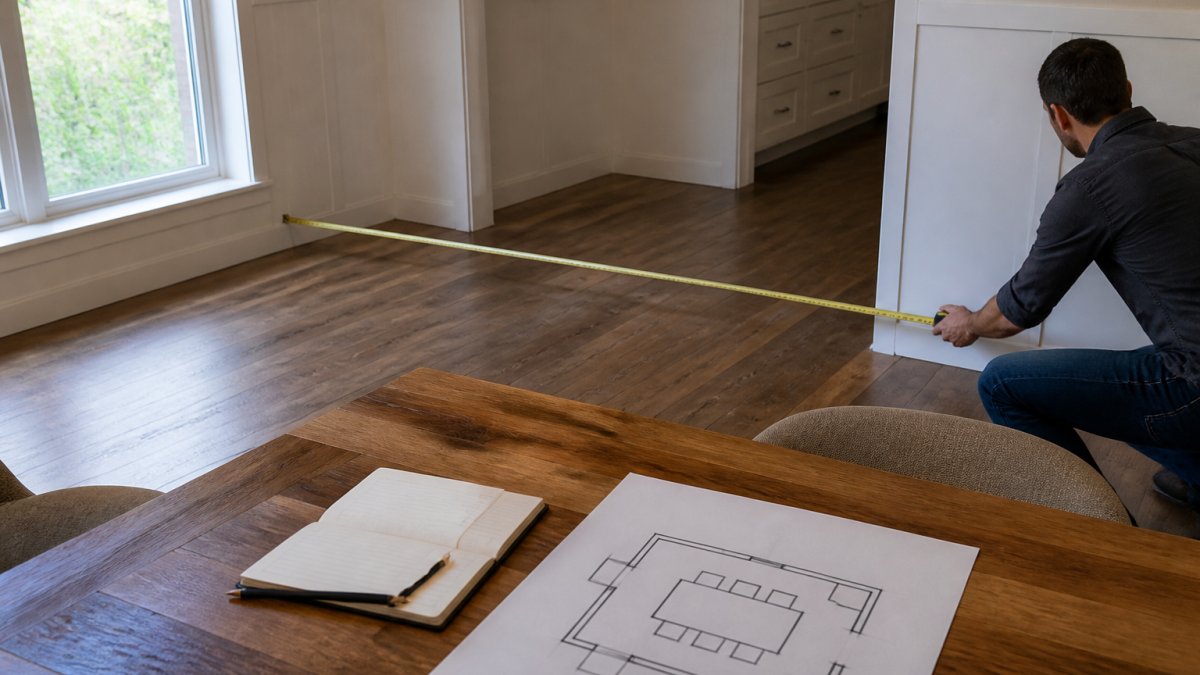
If your dining area is part of an open floor plan, measure the boundaries where the dining zone ends.
Step 2: Account for Clearance Space Around the Table
Most people measure the room and assume they can fit a table almost as large as the room itself. In reality, you need clearance space on all sides so people can pull their chairs out and move around comfortably.
The industry standard is 36 inches of clearance space around the table on all sides, measuring from the table edge to the wall or furniture behind it.
To calculate your maximum table dimensions, subtract 72 inches (36 inches on each side) from your room's length and width.
Step 3: Plan for Traffic Flow and Walkways
Beyond clearance around the table, think about how people move through the room. If your dining area connects to the kitchen, maintain a clear path from the table to the kitchen entrance.
Keep at least 36 inches of walkway space from the table edge to the nearest wall or furniture. This is separate from clearance space, it's about traffic flow through and past the table. If you have a narrow hallway leading into your dining room, measure that width to ensure your table doesn't block access.
Standard Dining Table Dimensions and Seating Capacity
Understanding standard dining table sizes helps you match what's available to what works in your space.
Rectangular Table Sizes
Rectangular tables are the most common shape, typically 36 to 42 inches wide.
Common rectangular table lengths are 48, 60, 72, 84, and 96 inches. A 48-inch table seats four people comfortably. A 60-inch table seats four to six. A 72-inch table seats six to eight. An 84-inch table seats eight to ten.

You need roughly 24 inches of linear table space per person for comfortable dining. A 72-inch table divided by 24 inches per person gives you three people per long side, or six people total.
Round Table Sizes
Round tables encourage conversation because everyone faces the center and take up less visual space in a room. A round table is measured by its diameter.
Common round table sizes are 36, 42, 48, 54, and 60 inches in diameter. A 36-inch round table seats two to three people. A 42-inch table seats three to four.
Round tables need the same 36-inch clearance on all sides. A 60-inch round table needs a room that's at least 132 inches in both directions. If your room is narrower in one direction, a rectangular table may work better.
Square Table Sizes
Square tables work well in certain spaces and create a more intimate gathering. Common sizes are 36, 42, 48, and 54 inches per side.
A 36-inch square table seats two to four people. A 42-inch table seats four to six. A 48-inch table seats four to six. A 54-inch table seats six to eight.
| Table Shape | Diameter/Length | Width | Seats | Best For |
|---|---|---|---|---|
| Rectangular | 48-72 inches | 36-42 inches | 4-8 | Narrow rooms, everyday dining |
| Rectangular | 84-96 inches | 36-42 inches | 8-12 | Large rooms, frequent entertaining |
| Round | 42-48 inches | N/A | 4-6 | Small to medium rooms, conversation |
| Round | 54-60 inches | N/A | 6-10 | Medium to large rooms, entertaining |
| Square | 36-48 inches | N/A | 2-6 | Compact spaces, intimate gatherings |
Dining Table Size for 6 People: Choosing the Right Fit
If you're looking to seat six people regularly, you have options that work in different room sizes.
A 72-inch rectangular table is the sweet spot for seating six comfortably, 24 inches per person along the long sides, with three people on each side.
A 60-inch rectangular table still seats six in shorter rooms, though it's slightly tighter and less balanced.
A 54-inch round table also seats six comfortably and takes up less linear space.

Dining Table Clearance Around Table: Getting the Space Right
Clearance determines whether the space actually functions for dining and movement. The difference between 30 inches and 36 inches of clearance is the difference between a space that works and one that feels tight.
Minimum Clearance Requirements
The minimum clearance space around a dining table is 30 inches. Anything less and people will feel cramped when they pull their chairs out.
The comfortable standard is 36 inches of clearance, giving enough space to stand, move sideways past seated diners, and pull a chair out without bumping into a wall.
Clearance matters more in rooms where the dining area connects directly to other spaces. A hallway that's 36 inches wide can't accommodate a dining table with 36 inches of clearance on both sides.
Accessibility and Mobility Considerations
Standard dining tables are 30 inches tall. If someone uses a wheelchair, they may need a table that's 32 to 34 inches tall to allow their legs to fit underneath.
A table with a pedestal base leaves more knee space than one with legs near the corners. If accessibility is a concern, a pedestal table gives wheelchair users more room to position themselves comfortably.
Dining Table Shapes for Small Spaces
When your dining room is tight, shape becomes critical. A rectangular table wastes less space in a narrow room, but a round table creates a better social experience in a confined area.
Round Tables: Maximizing Conversation in Tight Spaces
A round table in a small room creates an intimate gathering space where everyone can see each other. For a small dining area, a 42 or 48-inch round table is ideal.
A 48-inch round table needs 132 inches of space in all directions (an 11-by-11-foot space). A 48-inch rectangular table only needs 120 inches of length and 108 inches of width.
Round tables also limit chair arrangement, you can't add a chair at the "end" because there is no end. If you need flexibility to seat more people occasionally, a rectangular table is more adaptable.
Expandable and Drop-Leaf Tables: Flexibility Without Bulk
Expandable tables solve the problem of needing different sizes at different times. Drop-leaf tables have hinged leaves that fold down when not in use, taking up less space.
Expandable tables come with trade-offs. The expansion mechanism takes up space under the table, limiting leg room.
Drop-leaf tables are more elegant in small spaces because the leaves fold down completely. When collapsed, they take up very little space.
Both work well if you entertain occasionally but don't need maximum seating every day.
Matching Table Size to Your Lifestyle and Entertaining Needs
The right dining table size depends on how you actually use your dining room. If you eat breakfast there every morning, the table needs to fit your household comfortably.
Think about your most common dining scenario. A family of four eating together most nights needs a 60-inch rectangular table. A couple who entertains frequently benefits from a 72-inch table.

Consider the visual balance of the table in your room. A 48-inch table in a large dining room looks lonely; a 96-inch table in a small dining room looks overwhelming.
Common Mistakes When Sizing a Dining Table
The biggest mistake is measuring only the room and ignoring clearance.
The second mistake is choosing a table based on theoretical seating capacity without considering how often you actually need it.
The third mistake is ignoring the table's base and leg placement.
The fourth mistake is choosing shape based on aesthetics alone. If your room is long and narrow, a rectangular table is the only shape that makes sense.
Finally, people underestimate how much a table dominates a room. Showrooms are usually much larger than typical dining rooms.
Sizing a dining table correctly transforms your dining room from awkward to comfortable. When you've measured your space and know what you need, Shop our collection of live-edge and modern dining tables designed for homes that value quality and craftsmanship.
Frequently Asked Questions
What size dining table should I choose for a room that's 12 feet by 14 feet?
For a 12-by-14-foot dining room, a 60-inch rectangular or 54-inch round table works well. Measure your room carefully, then subtract 36 inches from each dimension to account for standard clearance space around the table. This gives you maximum usable table size while maintaining comfortable traffic flow and chair pull-out space. The Lakewood 72-inch table fits larger rooms with similar dimensions.
How much clearance space around a dining table is actually necessary?
Plan for at least 36 inches of clearance on all sides of your dining table. This allows enough space for chairs to pull out fully and people to walk behind seated diners without squeezing. In smaller spaces, 30 inches is the absolute minimum, though it feels tight. For entertaining and comfortable movement, 42 to 48 inches is ideal. Always measure from the edge of your table to walls, doorways, and other furniture.
What size dining table seats 6 people comfortably?
A 72-inch rectangular table or 60-inch round table seats 6 people with adequate elbow room. For rectangular tables, allow 24 inches of width per person and 15 inches of depth. Round tables work well for 6 diners as they encourage conversation and fit better in square rooms. The Preston 72-inch rectangular table and Balam 60-inch round table are both excellent options for seating 6 guests comfortably.
Is a round or rectangular table better for a small dining room?
Round tables are better for small spaces because they eliminate sharp corners, take up less visual floor space, and allow easier movement around them. They also encourage conversation by facing everyone toward the center. However, rectangular tables offer more seating in a smaller footprint if your room is narrow. Measure your exact dimensions first, then choose based on your room's shape and layout, not just its size.
How do I know if a 5-foot dining table is too small for my household?
A 5-foot (60-inch) table seats 4 people with comfort, or 5 with tight spacing. It's too small if you regularly entertain more than 4 guests or want generous elbow room for daily dining. Consider your lifestyle: do you host dinner parties often, or is it mainly family meals? If you frequently entertain, choose at least 72 inches. For small households that rarely host, 60 inches is adequate and saves valuable floor space.
What table base and leg placement should I consider when measuring for a dining table?
Verify that the table's base and legs don't interfere with chair placement. Pedestal bases offer more leg room than four-leg designs, allowing chairs to tuck closer underneath. When measuring, account for how far out the base extends from the table's edge. Check the manufacturer's specifications for leg positioning. This affects how many chairs you can actually fit and how comfortably diners can sit without bumping their knees or feet.
Can I use a rug to help define my dining table size and space?
Yes, a rug helps anchor your dining table and define the dining area visually. Choose a rug large enough that at least the front legs of all dining chairs rest on it when pulled out. For a 60-inch round table, use a 9-foot round rug. For a 72-inch rectangular table, a 9-by-12-foot rug works well. The rug should extend at least 24 inches beyond the table's edge on all sides to create a cohesive, intentional look.