

Table of Contents
- Why Custom Furniture Makers Matter: Beyond the Standard Option
- How to Choose a Custom Furniture Maker That Matches Your Vision
- Custom Live-Edge Dining Tables: Material, Design, and Durability
- Custom Furniture Cost: What You're Actually Paying For
- Custom Furniture Lead Time and Delivery: Planning Your Purchase
- Comparison Table: Custom Furniture Options and What Sets Them Apart
- Finding Your Ideal Custom Furniture Match
- Frequently Asked Questions
Last Updated: October 14, 2026
Why Custom Furniture Makers Matter: Beyond the Standard Option
Mass-produced furniture is designed to fit everyone, which means it fits no one particularly well. Custom furniture makers build pieces that match your exact vision, space, and lifestyle. Understanding custom furniture alternatives and what sets quality craftspeople apart from standard options is essential.
Commissioning a custom piece goes deeper than aesthetics. A well-crafted custom dining table or cabinet adapts to your dimensions, reflects your design preferences, and often lasts decades longer than factory-made equivalents.
How to Choose a Custom Furniture Maker That Matches Your Vision
Most people searching for an AZ Casona alternative want to tell a real custom shop from a reseller, a drop-shipper, or a maker who will take a deposit and disappear. Here are the questions that separate a legitimate custom furniture maker from a storefront that re-labels imported pieces.
Start with the AZ Casona question
AZ Casona is a known name in Arizona custom and semi-custom furniture, and buyers often want the same category of product, solid-wood dining tables, live-edge pieces, custom cabinetry, without committing to one brand. Evaluate any alternative maker with the same five questions:
- Who actually builds the piece? Ask whether the maker owns the shop or sources from a third-party factory. A maker who can name their shop, finisher, and lead builder is a maker; a seller who cannot is a reseller.
- What is the wood, and where did it come from? Ask for the species, moisture content target, and drying method. Kiln-dried hardwood stabilized for your climate behaves differently than air-dried stock.
- What is the deposit and payment structure? Custom shops commonly require a deposit at order with the balance at delivery; some require payment in full upfront. Both are legitimate, but know which one you are agreeing to before you sign.
- What is the written lead time, and what happens if it slips? A verbal "about a month" is not a commitment. Ask for the lead time in writing and the remedy if the date moves.
- What is the warranty, and who honors it? Ask what is covered (joinery, finish, structural), for how long, and whether the shop or a third party honors it.
Red flags that show up across the category
Complaints in this category usually stem from unclear communication, not bad craftsmanship. Watch for these signals:
- No physical shop address or shop visit option. Legitimate makers will let you see the workspace or confirm where it is.
- No written quote. A quote that exists only in a text thread is hard to enforce if scope changes.
- Vague material descriptions. "Solid wood" without a species is not a specification.
Match the maker to the project type
Not every maker is right for every job. Narrow the shortlist by project type:
- One-off statement piece (live-edge dining table, conference table): prioritize makers specializing in slab work with stabilized edges and documented drying.
- Custom cabinetry or vanities: prioritize shops with cabinet-specific experience, since casework tolerances and installation differ from table work.
- Commercial or hospitality furniture: prioritize makers who can produce repeatable pieces to spec and handle commercial delivery and installation.
Verify before you commit
Before placing a deposit: ask for two or three recent customer references, confirm the business is registered and in good standing with your state's business regulator, and check the Better Business Bureau for unresolved complaints. These checks take under an hour.
Better Business Bureau guidance on evaluating custom furniture makers
Custom Live-Edge Dining Tables: Material, Design, and Durability
Live-edge dining tables are increasingly popular, but not all are created equal.
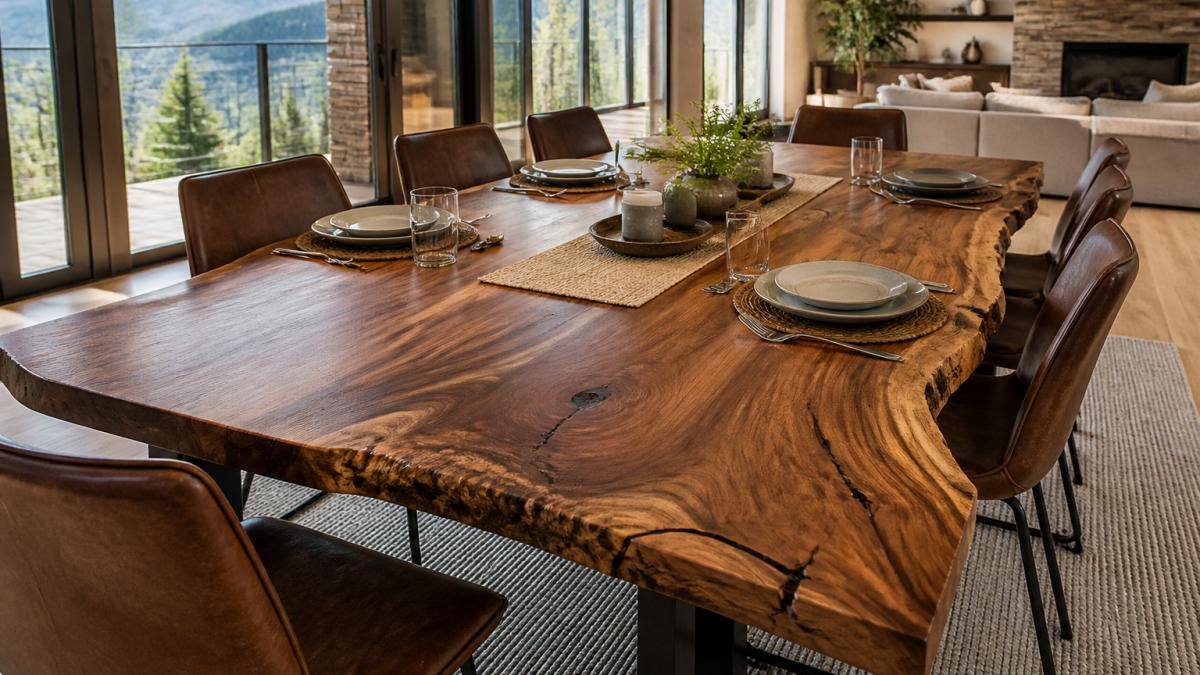
Wood species matters.
Epoxy or resin inlays stabilize the live edge and add visual interest.
Drying is where quality separates from mediocrity. Properly kiln-dried wood has moisture content stabilized to match your home's climate.
Thickness matters too. A substantial tabletop, typically 1.5 to 2 inches, provides visual presence and structural integrity.
Custom Furniture Cost: What You're Actually Paying For
Custom furniture pricing confuses buyers who compare it to mass-produced alternatives. You are not paying a premium for the same product, you are paying for an entirely different value proposition. Here is how a custom quote is built.
The five line items inside a custom quote
A well-structured custom furniture quote usually breaks into five parts. If a maker hands you a single number with no breakdown, ask for it.
- Material. Solid wood sourced responsibly, properly dried, and selected for grain and stability costs more than veneer or particle board. A live-edge table in solid acacia or parota requires careful slab selection and preparation that factory production skips. Species, thickness, and slab width all move the number.
- Labor. A skilled craftsperson spends roughly 40-80 hours on a custom dining table, including design consultation, wood selection and preparation, joinery, finishing, and quality control. You are paying for expertise that takes years to develop.
- Custom sizing and joinery. A table built to fit your specific space, an unusual length, a particular height, a bench that tucks under, requires custom joinery and base adjustments. This is where a "standard size" quote and a "custom size" quote diverge.
- Finish and detail. Hand-sanding, staining, sealing, and protective topcoats take time. Epoxy inlays add visual drama, material cost, and labor because the pour and cure must be controlled.
- Delivery and installation. A large dining table requires professional handling to prevent damage. Delivery, in-home placement, and assembly are real costs that vary by distance and access (stairs, elevators, narrow doorways).
How deposits and payment schedules typically work
Custom shops generally use one of two structures: a deposit at order (often a percentage) with the balance due at delivery or pickup, or payment in full upfront, common when the shop must buy a specific slab or commission a finish. Neither is inherently a red flag, what matters is that the structure is written down before you pay. Ask what triggers the deposit and the balance, and what happens to the deposit if you cancel or the shop misses the date.
What to bring to a quote request
The biggest driver of quote accuracy is the information you provide. Makers who receive a one-line inquiry either pad the number or guess. Bring these six items:
- Photos of the room and intended placement
- Approximate dimensions (length, width, height) and hard constraints (doorway width, ceiling height)
- Intended use (daily family dining, occasional hosting, commercial traffic)
How to compare two quotes apples-to-apples
Two quotes for "a custom dining table" are rarely comparable as written. Normalize them first:
- Species and grade: acacia vs. parota vs. walnut are not the same material cost.
- Thickness: a 1.5-inch top and a 2-inch top are different products.
- Base construction: trestle, X-frame, and pedestal bases use different amounts of material and labor.
A note on price expectations
Because custom work is built to order, published prices are starting points, not final numbers. A maker may publish a starting price for a standard size and quote upward for custom length, thicker stock, or a specialty finish. Treat any published starting price as the floor of a range, and ask what is included versus an add-on.
Sparks Ridge Canyon Dining Table →
Custom Furniture Lead Time and Delivery: Planning Your Purchase
Timeline expectations separate realistic makers from those overpromising. Most quality custom furniture makers require time for proper construction and finishing.
Mt. Modern's approach is transparent: custom Sparks Ridge tables require approximately 3-4 weeks, with payment in full when the order is placed.

Delivery logistics vary by location. For Arizona customers, Mt.
Mt. Modern offers free pickup in Cottonwood and Show Low, letting you inspect the finished piece before transport.
Comparison Table: Custom Furniture Options and What Sets Them Apart
| Table | Material | Starting Price | Best For | Custom Sizing | Lead Time |
|---|---|---|---|---|---|
| Sparks Ridge Canyon | Solid acacia | $1,199 | Modern dining with natural grain | 60-99 inches | 3-4 weeks custom |
| Sparks Ridge Summit | Solid acacia | $1,199 | Contemporary spaces with X-frame base | 60-99 inches | 3-4 weeks custom |
| Raramuri Copper-Epoxy | Live-edge wood with copper-toned epoxy details | $2,893.40 | Statement pieces with modern metallic accent | Standard sizes | In stock / custom available |
| Riverwood Parota & Resin | Live-edge parota wood with resin accents | $2,830.50 | Industrial modern aesthetic | Standard sizes | In stock / custom available |
| Natural Parota 95″ | Live-edge parota wood | $2,650.30 | Large dining spaces needing dramatic scale | 95 inches standard | In stock / custom available |
Each option balances material, aesthetic, and customization differently. The Sparks Ridge tables offer the most sizing flexibility and the most accessible price point for custom work. The International Furniture Direct collections (Raramuri, Riverwood, Natural Parota) provide statement pieces with specialized finishes and larger scale.

Finding Your Ideal Custom Furniture Match
Your ideal custom furniture maker depends on what matters most: budget, timeline, design aesthetic, and service area.
If you prioritize customization and affordability, the Sparks Ridge tables from Mt. Modern offer a compelling option.
If you want a statement piece that becomes the focal point of your dining room, the International Furniture Direct collections deliver. The Raramuri's copper epoxy inlay creates visual drama, while the Riverwood's dark resin accents provide industrial contrast.

Location matters for convenience. Mt. Modern's statewide delivery at $199 includes professional in-home placement, eliminating transport damage risk.
Design preference narrows your options. The Sparks Ridge collections suit modern minimalist spaces where the wood's natural beauty takes center stage.
Finding the right custom furniture alternatives means understanding what drives quality and longevity. Modern makes distinctive, high-quality custom furniture accessible across Arizona. Shop the Sparks Ridge and International Furniture Direct collections to see how custom craftsmanship transforms a dining space.
American Furniture Manufacturers Association standards on wood durability
Fine Woodworking's guide to wood movement and seasonal changes
Better Business Bureau guidance on evaluating custom furniture makers
Frequently Asked Questions
How long does it take to have custom furniture made?
Custom furniture lead time depends on the maker and design complexity. Before ordering, confirm the specific timeline with your maker, some offer expedited options, while others build each piece individually. Factor in delivery time separately, especially if you're furnishing a vacation home or coordinating with other renovations.
What should I compare when choosing a custom furniture maker?
Evaluate material quality (solid wood versus veneers), wood species and sustainability practices, customization options (length, base style, finishes), pricing transparency, delivery and pickup availability, warranty coverage, and craftmanship details. Request photos of completed projects in actual homes, ask about their drying process for wood to prevent warping, and verify whether pieces are truly one-of-a-kind or mass-produced. Local makers often offer in-home pickup, which lets you inspect before finalizing payment.
Is custom furniture more expensive than ready-made furniture?
Custom furniture typically costs more than mass-produced alternatives because each piece is individually crafted and tailored to your specifications. Prices vary widely based on materials, wood species, size, and maker reputation. Live-edge tables with epoxy or resin details command higher prices due to material quality and labor. However, custom pieces often last longer and hold their value better, making them a long-term investment rather than a short-term purchase.
What wood is best for a durable custom dining table?
Solid hardwoods like acacia and parota are excellent choices for dining tables because they resist warping and wear well over time. These species offer distinctive grain patterns and natural beauty while maintaining structural integrity. Avoid veneers for high-use surfaces. Ask your maker about their wood sourcing, drying process, and finishing techniques, proper kiln drying and quality sealants prevent cracking and ensure longevity. Reclaimed wood offers character but requires expert assessment for stability.