

Quick Summary
To style a live edge table in a modern room, choose a wood tone that repeats a color already in the room and pair it with a simple base such as matte black metal legs. Then size the table so each seated diner gets about 24 inches and keep 36 inches of clearance from walls. Keep tabletop decor minimal so the natural edge stays the focal point.
- Pick one wood tone and repeat it once or twice elsewhere in the room.
- Allow about 24 inches of table width per seated diner along each long side.
- Keep about 36 inches of clearance from the table edge to the nearest wall.
- Hang a pendant 30 to 36 inches above the table surface.
- Limit tabletop decor to about one-third of the surface area, leaving the live edge clear.
Table of Contents
- How to Style a Live Edge Table in a Modern Room
- Why a Live Edge Table Works in a Modern Room
- Choosing a Wood Species and Tone to Match Your Palette
- Live Edge Table Base Design: Choosing Legs That Support a Modern Look
- Live Edge Dining Table Ideas for Room Scale, Layout and Lighting
- Live Edge Table Chairs That Balance Natural Wood
- Live Edge Table Decor: Restrained Styling That Keeps the Wood the Focal Point
- Start Styling Your Room: Choose Your Table and Book Pickup or Delivery
- Frequently Asked Questions
How to Style a Live Edge Table in a Modern Room
Last Updated: November 5, 2026
Why a Live Edge Table Works in a Modern Room
A live edge table is one of the few furniture pieces that brings natural character into a clean, contemporary space. The wood keeps its original outer edge, so every curve and knot tells a story. Modern rooms often feel cold or flat, and a live edge table adds warmth without clutter.
Mt. Modern builds its collection around this balance. Our live-edge dining tables and Arizona mesquite pieces pair organic shapes with modern lines.
The trick is letting the wood do the talking. When the rest of the room stays simple, the table becomes the focal point. That's the core idea behind every styling choice in this guide.
Choosing a Wood Species and Tone to Match Your Palette
Start with the wood, because it sets the tone for everything else. Lighter woods like maple and ash feel airy and Scandinavian-leaning. Walnut and darker mesquite tones lean moody and sophisticated.
Match the wood to what already lives in your room:
- Cool gray walls: Pair with lighter wood tones for contrast
- Warm white or cream walls: Darker wood grounds the space
- Earth-toned rugs and textiles: Mid-tone wood ties everything together
- Black accents: Walnut or deep mesquite looks crisp
Don't try to match every finish. Pick one wood tone and repeat it once or twice in the room, such as in a frame or a small side table.
Live Edge Table Base Design: Choosing Legs That Support a Modern Look
The base changes the whole personality of the table. A thick slab on slim metal legs reads modern and light. A chunky slab on a solid base feels more grounded and rustic.
For a modern look, consider these base styles:
- Metal legs: Matte black or brass legs keep lines clean
- Trestle bases: Provide a sculptural, open feel
- Straight legs: Offer a minimal profile that lets the slab stand out
Mixed materials work well. A wood slab with black metal legs is a classic pairing. Avoid bases with too many decorative details, since they compete with the natural edge.
Watch out: A heavy slab on thin legs can look unstable. Check that the base is sized to the slab's weight before you buy.
Live Edge Dining Table Ideas for Room Scale, Layout and Lighting
Most styling guides stop at "leave enough room to walk." The numbers below turn that advice into a plan you can measure before you buy, which is the part competitors skip.
Start with table size, not chair count. A common pattern is to allow 24 inches of table width per seated diner along each long side, with 30 inches of table length per person at the ends if you seat anyone there. That puts a comfortable four-person table at roughly 48 by 36 inches and a six-person table at roughly 72 by 36 inches. Live edge slabs rarely come in perfect rectangles, so measure the widest point and the narrowest point and plan seating around the narrower figure.
Then add chair clearance. You need about 36 inches from the table edge to the nearest wall, sideboard, or sofa so a chair can slide back and a person can pass behind it. If the table sits against a wall, keep at least 30 inches on the working sides. In a room narrower than about 10 feet, a 36-inch-wide table leaves only about 24 inches per side once you subtract the table, tight for a walkway, workable only if the dining zone is not a pass-through.
Match the layout to the room type:
- Small dining room (under 120 square feet): Choose a 48- to 60-inch table, skip the sideboard, and use a round or oval slab if you can find one so corners do not crowd the walkway.
- Open-plan space: Define the dining zone with a rug that extends at least 24 inches beyond the table edge on all sides, and align the pendant to the table center rather than the room center. A rug that stops at the chair legs makes the table look like it is floating.
- Narrow room: Run the table's long axis parallel to the long wall and use benches on the wall side to cut the chair pull-out depth.
Lighting dimensions that actually work. Hang a pendant or linear fixture so the bottom sits 30 to 36 inches above the table surface, lower for a linear fixture over a long table, higher if diners stand frequently. Size the fixture to roughly one-half to two-thirds the table's length so it reads as belonging to the table, not the ceiling. For a 72-inch table, a 36- to 48-inch linear fixture is a common fit. Center the fixture on the slab's visual center, which on a live edge table is often not the geometric center because one edge wanders.
Watch out: A pendant hung at the standard 30-inch height over a table that doubles as a homework or laptop surface will be in the way; raise it to 36 inches or switch to a flush or semi-flush fixture if the table is multi-use.
Raramuri Live-Edge Copper-Epoxy Dining Table →
The article's room-scale figures can be scanned at a glance:
| Item | Value | Note |
|---|---|---|
| Table width per seated diner | 24 inches | Along each long side |
| Table length per person at ends | 30 inches | If seating anyone at the ends |
| Chair clearance to nearest wall | 36 inches | Keep at least 30 inches on working sides |
| Pendant bottom above table | 30 to 36 inches | Higher for frequent standing or multi-use tables |
| Pendant length vs. table length | One-half to two-thirds | Example: 36 to 48 inch fixture over a 72-inch table |
| Rug extension beyond table edge | At least 24 inches | On all sides in open-plan spaces |
| Narrow room threshold | Under about 10 feet | Leaves only about 24 inches per side with a 36-inch table |
Live Edge Table Chairs That Balance Natural Wood
Chairs help the table feel intentional. Upholstered chairs in neutral fabrics soften a live edge slab. Wood or woven seats add texture that echoes the natural material.
Mix chair styles carefully. Two or three chair types usually look curated, while five different styles can feel scattered. A consistent finish, like black metal or light oak, keeps the set cohesive.
Live Edge Table Decor: Restrained Styling That Keeps the Wood the Focal Point
A live edge slab already carries more visual information than a factory edge, knots, sapwood, cracks, and a wandering profile. Decor competes with that information, so the goal is not "minimal" for its own sake but keeping the object count low enough that the eye still lands on the edge.
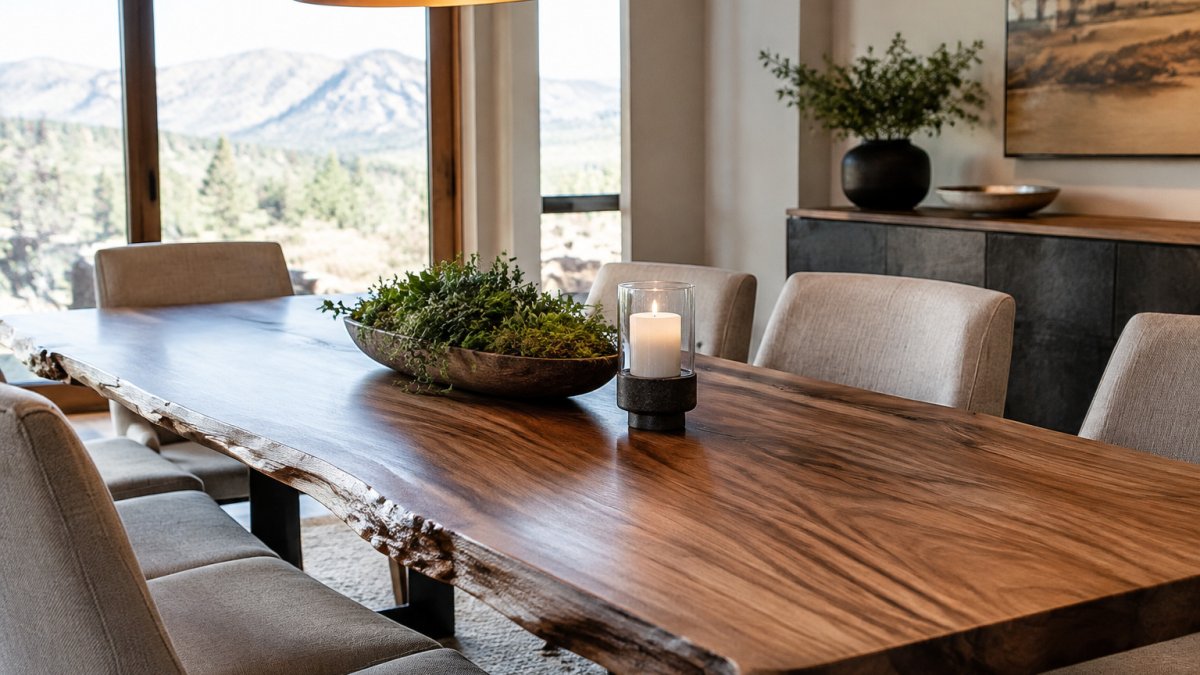
Use a size rule instead of a vibe. Keep tabletop decor within roughly one-third of the table's surface area and leave the outer 6 to 8 inches of the live edge clear on at least one long side. That clear band is what lets guests see the edge while seated and what keeps the slab readable from across the room.
Build the arrangement in three layers:
- A low base layer, a runner, a shallow bowl, or a planter no taller than about 8 inches so sightlines across the table stay open.
- One vertical element, a single stem, a candlestick, or a small vase, placed off-center at roughly the one-third point of the table length rather than dead center.
- One textural accent, a linen runner, a stone tray, or a woven mat that echoes the wood without matching it.
Stop there. A common pattern is that a fourth object is what tips a table from styled to cluttered.
Coordinate with the room, not the table. Repeat one material from the room, black metal from the base, brass from a light fixture, or the rug's dominant tone, once on the tabletop. Repeating a material twice starts to look like a set; once reads as intentional.
Protect the slab while you style it. Live edge wood is usually finished with oil, wax, or a film finish, and each reacts differently to heat and moisture. Use coasters and trivets under anything hot or wet, wipe spills promptly, and avoid placing a wet planter directly on the wood, set it on a tray or a cork mat. Felt pads under heavy objects prevent scratches when the table is used for projects, not just meals. If the finish is oil or wax, plan on re-oiling periodically; a film finish needs less routine upkeep but shows scratches more.
Watch out: A tall centerpiece that looks great in photos will block conversation across a 36-inch-wide table; keep the tallest element under about 12 inches unless the table is wider than 40 inches.
Start Styling Your Room: Choose Your Table and Book Pickup or Delivery
Ready to begin? Work through the steps in order: pick your wood tone, choose a base style, plan the room scale and lighting, then add chairs and restrained decor.
If you want to see pieces in person, browse our Raramuri live-edge dining table collection and compare finishes side by side. For a matching accent piece, the Ember Canyon live-edge chairside table works well beside a dining set.


Customers in the Cottonwood and Show Low area can arrange free pickup. Elsewhere in Arizona, delivery is available with a flat rate of $199 per order, including in-home placement and assembly when required. Our modern style collection is a good starting point if you want to see how these pieces fit together.
Frequently Asked Questions
How do you make a live edge table look modern?
Pair the live edge slab with clean-lined chairs, a simple metal or matte black base, and a restrained centerpiece. Keep wall color neutral and let the grain and natural edge stay the focal point. Avoid heavy rustic accessories, and choose a base that is clearly contemporary so the table reads as deliberate rather than farmhouse. Mt. Modern's Raramuri Live-Edge Copper-Epoxy Dining Table pairs its copper-toned epoxy with a purposeful base for a modern statement.
What chairs go best with a live edge dining table?
Upholstered or simple wood-frame chairs with clean lines work well because they balance the organic shape of the slab. Choose chairs in a color that contrasts with the wood tone rather than matching it exactly. Mixing one or two chair styles can add interest, but keep the seat height consistent so the table feels settled and proportioned in the room.
What lighting works with a live edge dining table?
A single linear or pendant fixture centered over the table, hung roughly 30 to 36 inches above the surface, usually works well in a standard dining room. Warm-temperature bulbs bring out the grain of the wood. Keep the fixture's visual weight modest so it does not compete with the natural edge of the slab.
How do you decorate around a live edge coffee table?
Limit surface decor to two or three items: a low planter, a candle holder or a stack of books. Keep the middle of the table open so the grain and natural edge are visible. Place a textured throw or simple wall art nearby to echo the natural materials without crowding the piece.
