

Table of Contents
- What Kiln Drying Actually Does to Wood
- Kiln-Dried vs Air-Dried Wood for Furniture
- Kiln-Dried Wood Moisture Content for Furniture
- Wood Moisture Meter for Furniture: How to Check Before You Build
- Wood Movement in Furniture: Why Stability Matters More Than Hardness
- Kiln-Drying Trade-Offs and Defects You Should Know
- How to Choose Kiln-Dried Lumber for Your Project
- Conclusion: When Kiln-Dried Wood Is Worth It
- Frequently Asked Questions
Last Updated: October 8, 2026
What Kiln Drying Actually Does to Wood
Kiln dried wood is produced by a controlled process that removes moisture from lumber inside a heated chamber where temperature, humidity, and airflow are managed to a set schedule. Freshly cut, or "green," lumber holds far more moisture than it ever will in your living room, and that excess has to go before the wood becomes a dining table.

The process works in stages: air moves heat through the stack, water evaporates from the board surfaces, and moisture migrates from the core outward.
A common mistake is assuming kiln drying just means "dried faster." It means dried deliberately, with the moisture gradient controlled at every step, air drying leaves that gradient to the weather.
The practical payoff for furniture is straightforward: lumber that has already given up its free water won't keep moving after you build with it.
Kiln-Dried vs Air-Dried Wood for Furniture
For furniture, kiln-dried lumber is usually safer: it reaches a lower, more consistent moisture content in less time and reduces the insect risk of slow outdoor drying.
Here's the honest comparison:
| Factor | Kiln-Dried | Air-Dried |
|---|---|---|
| Moisture content | Controlled to a target, often 6-8% | Depends on local climate, often 12-20% |
| Drying time | Weeks, not years | Months to years |
| Uniformity | Consistent across the stack | Uneven, outer boards dry first |
| Insect risk | Reduced by kiln heat | Higher, pests survive longer |
| Cost | Higher, due to energy | Lower |
| Best for | Furniture, cabinetry, indoor work | Outdoor projects, rustic builds |
Where air-dried stock still earns its place. Air drying is gentler on some species and can produce richer color, because slow drying lets extractives and pigments settle differently than a fast kiln schedule.
When air-dried is the right call. Outdoor furniture, garden benches, and pieces in unconditioned spaces are fine, often better, in air-dried stock, because the wood equilibrates to the same humid outdoor air it was dried in. A rustic slab table on a screened porch is reasonable; a dining table in a climate-controlled dining room is not.

A note on "kiln-dried" as a label. The term covers a wide range of schedules. A board dried to 6% under a slow, species-matched schedule and one rushed to 6% under high heat are both technically kiln-dried, but only one is good furniture stock. The number on the tag is a starting point, not a guarantee.
Kiln-Dried Wood Moisture Content for Furniture
This is the part that actually matters. Wood doesn't care that it was kiln-dried; it cares what the air around it is doing now.
Match the target to the room, not the label. A practical way to think about it:
- Climate-controlled indoor furniture (heated and air-conditioned home, year-round): target 6-8%. This is the sweet spot for most dining tables, desks, and casegoods.
- Semi-conditioned spaces (sunrooms, screened porches, mountain homes with wide humidity swings): target 8-10%, because the wood will equilibrate higher than a sealed house.
- Unconditioned or outdoor pieces: target 10-12% or higher, matched to the local average. Drying below the destination EMC just means the wood gains moisture and swells after delivery.
Why the swing matters more than the average. A room averaging 7% EMC but swinging from 4% in winter to 10% in summer moves wood more than one sitting steadily at 8%.

Acclimation is the step most builders skip. Even correctly kiln-dried lumber needs to sit in the shop where it will be milled until it stabilizes.
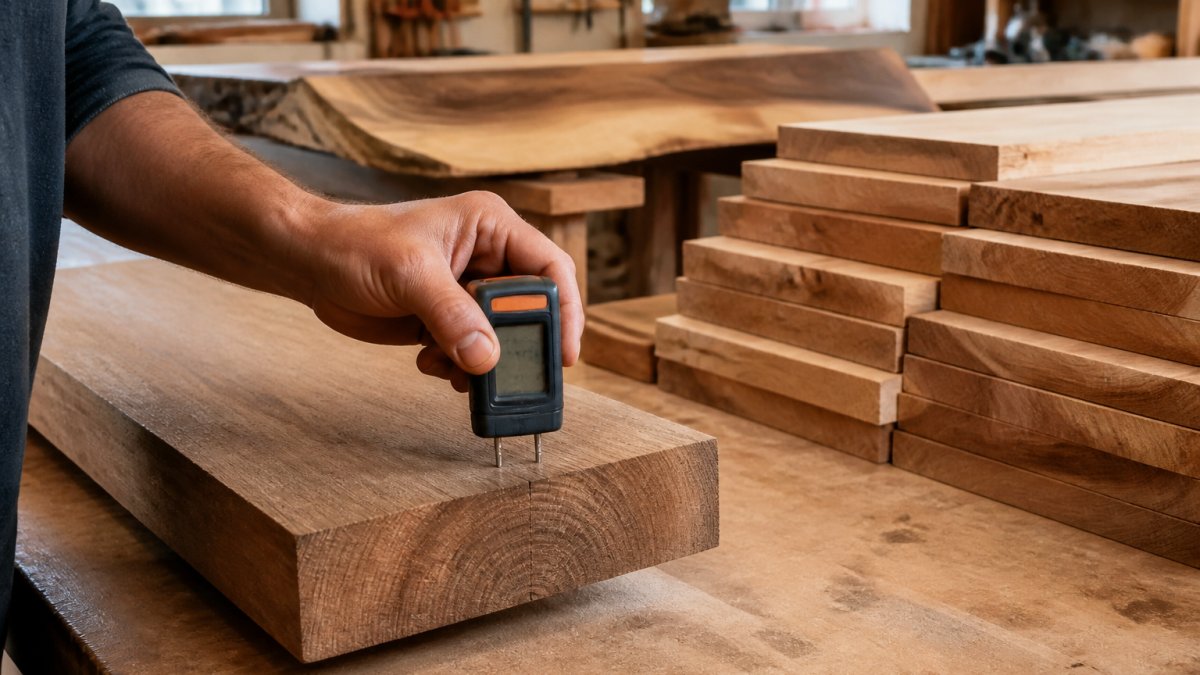
How to verify the number yourself. Don't rely on the supplier's word alone. A pin-type moisture meter pushed into the end grain and face of several boards gives you a real reading. Test multiple boards from the same stack, read the ends and the middle, and push the pins to roughly one-quarter of the board's thickness. Large variation across a stack means uneven drying, a red flag regardless of the average.
Wood Moisture Meter for Furniture: How to Check Before You Build
A wood moisture meter for furniture turns "kiln-dried" from a label into a measurement.
Pin-type meters are more accurate on thick stock and read at a specific depth. Pinless meters are faster and leave no holes, which matters on finished surfaces.
How to check a board properly:
- Test several boards from the same stack, not just the top one
- Take readings at the ends and the middle of each board
- Push pins to roughly one-quarter of the board's thickness for a representative reading
- Compare readings across the stack; large variation means uneven drying
- Recheck after the lumber has acclimated in your shop for a few days
The number you're looking for depends on your project and your climate, but for indoor furniture in a controlled space, readings in the mid-single digits are the goal.
Wood Movement in Furniture: Why Stability Matters More Than Hardness
Wood movement in furniture is the seasonal expansion and contraction of wood as it gains and loses moisture, and it happens in every piece regardless of species or finish.
Dimensional stability determines how much a given board will move.
This is the part most buyers miss: the drying and the joinery do more for a table's long-term behavior than the species name on the tag.
Kiln-Drying Trade-Offs and Defects You Should Know
Kiln drying is not risk-free. When a schedule is rushed or the operator pushes temperature too hard, defects appear:
- Casehardening: the outer shell dries and sets while the core stays wet, locking stress into the board that shows up as cupping or springing when you rip it
- Checking and cracking: surface or internal cracks from drying too fast
- Honeycomb: internal voids that you can't see until the board is cut
Good kiln operators manage all of this with a schedule matched to species and thickness, plus equalizing and conditioning phases at the end. The trade-off is real: kiln drying costs more and takes skill, and a bad operator can ruin a good board. But uncontrolled air drying has its own failure modes, just slower ones.
How to Choose Kiln-Dried Lumber for Your Project
Choosing kiln-dried lumber comes down to matching the moisture content to the project and room, then verifying it yourself. Work through these steps before you commit to a board:
- Know your target. Indoor furniture in a controlled space wants drier stock than a piece headed for a semi-open room.
- Ask for the moisture content. A reputable supplier can tell you the target the lumber was dried to.
- Measure it. Bring your meter and check multiple boards, ends and middles.
- Match the species to the job. Stable species and quartersawn stock move less; use them where movement matters most.
- Acclimate before milling. Let the lumber sit in your shop, stickered and off the floor, until it stabilizes.
- Store it right. Keep stock flat, supported, and away from direct heat or damp floors.
For buyers rather than builders, the same logic applies to finished furniture. A live-edge dining table is only as stable as the lumber under it, which is why the drying process and joinery deserve as much attention as the grain.
At Mt. Our Lakewood 72-inch Dining Table and Mezquite II 87-inch Dining Table are solid-wood pieces where natural grain, knots, and color variation are part of the character, not defects to hide.
Conclusion: When Kiln-Dried Wood Is Worth It
Kiln-dried wood is worth it whenever the piece will live indoors and you care whether it stays flat, most furniture, most of the time.
The challenge is that "kiln-dried" on a tag tells you almost nothing on its own.
Browse our live-edge dining tables and Arizona mesquite pieces, or stop by for free pickup in Cottonwood or Show Low and inspect the grain yourself before you commit.
Frequently Asked Questions
Is kiln-dried wood better than air-dried wood for furniture?
For most furniture, yes. Kiln drying brings moisture content down to a range suited to indoor use, usually 6 to 8 percent, in days rather than months. Air-dried lumber often sits closer to 12 to 15 percent depending on local humidity. Furniture built from kiln-dried stock is less likely to shrink, crack, or rack once it moves into a heated or cooled room. Air-dried wood can work, but it needs longer acclimation and careful moisture checks before milling.
What moisture content should wood have for furniture?
Most indoor furniture performs best when the wood settles between 6 and 8 percent moisture content, which matches the equilibrium moisture content of a typical climate-controlled home. In drier regions, wood can safely sit closer to 5 or 6 percent. For pieces headed to a humid vacation home, 8 to 10 percent may be more appropriate so the wood does not swell after delivery. Always match the target to the room where the furniture will live.
Can I build furniture with freshly cut wood?
You can, but freshly cut green wood moves dramatically as it dries. A green board can shrink several percent across its width, which is enough to split joints, cup tabletops, and pull apart frames. If you want to use green wood, plan for shrinkage in the design, allow long air-drying, and finish with a moisture check before final assembly. For most furniture projects, kiln-dried stock saves time and reduces the risk of defects.
Does kiln drying prevent wood from cracking or warping?
Kiln drying greatly reduces the risk, but it does not eliminate it. Properly dried lumber leaves the kiln at a moisture content close to its final environment, which limits the movement that causes cracks and warp. If the wood is stored in a damp garage or moved into a dry room without acclimating, it can still move. Acclimating boards in the shop for a week or two before milling is the step that locks in the kiln's work.
How can you tell if wood is properly kiln-dried?
The most reliable method is a moisture meter. Push the pins into the face or end grain of a board and look for a reading in the 6 to 8 percent range for indoor furniture. You can also check for kiln marks, a small stamp or chalk notation on the end of the board, and ask the supplier for the kiln schedule. Boards that feel unusually heavy or cold to the touch are often still holding excess moisture.
Does kiln-dried wood burn faster?
Kiln-dried wood does burn more efficiently than green or air-dried wood because the drying process removes much of the water that would otherwise absorb heat. That makes it a popular choice for firewood and for furniture makers who want predictable results. For furniture, the low moisture content is the point: it keeps the wood stable. For a fireplace, it means a hotter, cleaner burn with less creosote buildup.
What are the disadvantages of kiln-dried wood?
Kiln drying costs more than air drying because it requires controlled heat, airflow, and time in a kiln. If the schedule is rushed, the wood can develop casehardening, honeycombing, or internal cracks that only show up after milling. Some species also lose a bit of the rich color that slow air drying produces. The trade-off is usually worth it for furniture, where stability and predictable moisture content matter more than appearance during drying.
Is 10% moisture in wood bad for furniture?
Ten percent is on the high side for indoor furniture in most U.S. homes. In a dry climate or a heated room, wood at 10 percent will continue to lose moisture after assembly, which can open joints and cup tabletops. In a humid coastal or mountain home, 10 percent may be closer to the equilibrium moisture content and could be acceptable. Check the meter reading against the humidity of the room where the piece will live before deciding.
Furnishing a space with wood that moves is a decision you make once, and it should be the right one. Mt. Modern offers distinctive, high-quality furniture with convenient local pickup and Arizona-wide delivery, so you can see and feel the craftsmanship before it lands in your home. Explore our collection and find a piece built to stay flat, season after season.