

Table of Contents
- Live Edge Dining Table Styles: Rustic, Modern, and Organic Design
- Live Edge Dining Table Price: What You Pay and Why
- Live Edge Dining Table Sizes: Seating Capacity and Dimensions
- Live Edge Epoxy Dining Table: Resin Accents and Trade-Offs
- Construction Quality: What to Check Before You Buy
- Live Edge Dining Table Care: Cleaning and Long-Term Maintenance
- Frequently Asked Questions
Last Updated: October 16, 2026
Live Edge Dining Table Styles: Rustic, Modern, and Organic Design
A live edge dining table keeps the tree's natural outer contour, so one or both long sides follow its curve instead of a straight milled line.
At Mt. Modern, we build our collection around that idea: unlike a conventional solid wood top, the live edge is the design, not a finish applied to it.
Three style directions cover almost every room we furnish, each driving edge treatment, base, finish, and surrounding materials.
Rustic
Rustic leans into the tree. Knots, fissures, checks, and a heavily irregular natural edge stay visible. The wood looks like it came from a specific tree because it did. This suits mountain homes, timber ceilings, stone fireplaces, and rooms that already have texture.
- Edge treatment: Full natural contour, unfilled checks left as character, occasional bark inclusion
- Base pairing: Heavy timber trestles, thick steel U-frames, or forged-look iron
- Finish direction: Matte oil or low-sheen lacquer that lets the grain read raw
- Room context: Log cabins, timber-frame great rooms, stone-walled dining rooms, homes with leather and wool already in the palette
- Watch out for: Too much rustic in a small, bright room can read heavy. If your space is light and open, consider organic instead.
Modern
Modern tames the edge without removing it: the slab stays organic while the base is crisp and architectural, usually steel or a clean geometric wood frame. Most of our tables take this direction, letting a live edge piece sit in a contemporary dining room without looking like a cabin leftover.
- Edge treatment: Softened live edge, one straight side is common, minimal visible checking
- Base pairing: Slim steel U-frames, X-bases, or cantilevered wood frames with a powder-coated finish
- Finish direction: Satin or matte lacquer, sometimes a subtle whitewash or smoked treatment
- Room context: Open-plan kitchens, glass-walled dining rooms, homes with concrete, black metal, or pale oak floors
- Watch out for: A very thin slab on a very slim base can look unstable. Aim for at least 1.75 inches of thickness on a modern build.
Organic
Organic sits between the two. The grain is the focal point, the edge is softened rather than wild, and the palette stays warm and neutral, reading calm in a way rustic rarely does.
- Edge treatment: Gentle live edge, softened corners, cracks stabilized but not hidden
- Base pairing: Sculpted wood bases, tapered legs, or warm-toned metal with a brushed finish
- Finish direction: Natural oil, warm satin, or a light ceruse that lifts the grain without whitening it
- Room context: Neutral dining rooms, linen and rattan palettes, homes with plaster walls, jute rugs, and soft daylight
- Watch out for: Organic can drift toward bland if every surface is the same tone. Add one contrast material, black metal, dark ceramic, or a single deep-colored chair, to anchor it.
How the three compare at a glance
| Style | Edge | Base | Finish | Best Room |
|---|---|---|---|---|
| Rustic | Full natural contour | Timber or heavy steel | Matte oil | Timber, stone, leather |
| Modern | Softened, often one straight side | Slim steel or geometric wood | Satin or matte lacquer | Open plan, concrete, glass |
| Organic | Gentle, stabilized | Sculpted wood or brushed metal | Natural oil or warm satin | Neutral, plaster, linen |
Where does epoxy fit? Some buyers want cracks filled and stabilized with resin, creating a river table effect. We cover that trade-off below.
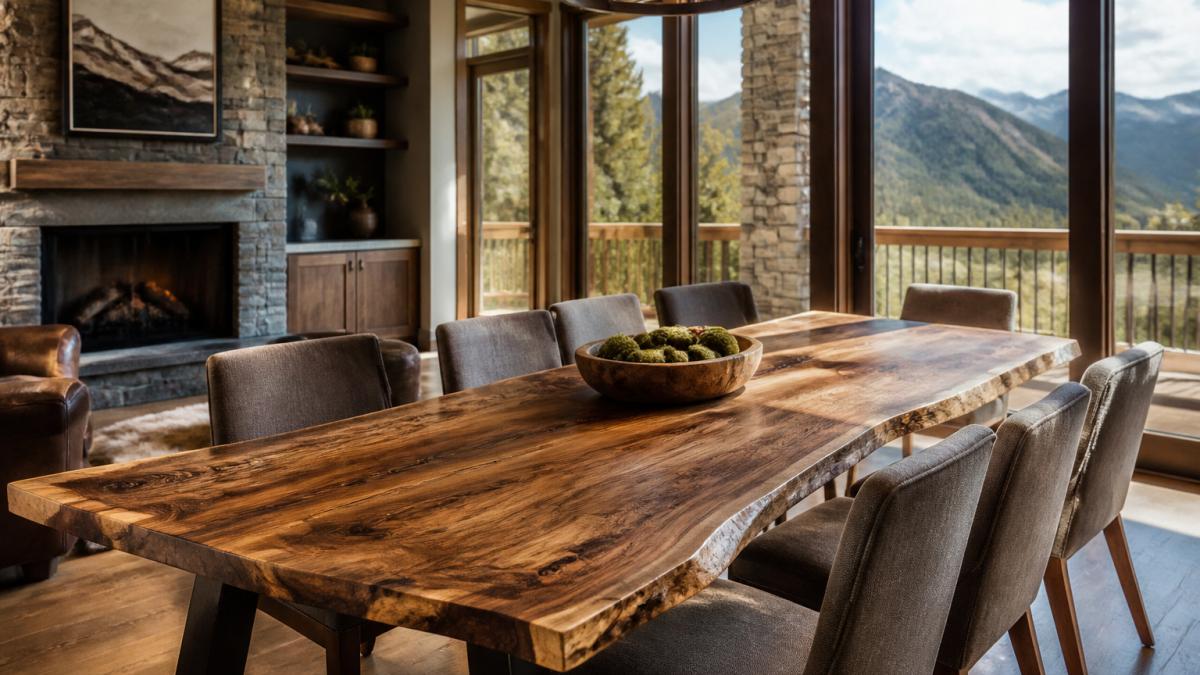
Live Edge Dining Table Price: What You Pay and Why
Most of the cost sits in the slab, not the base.
Here is our current range, so you can compare like for like:
| Table | Top Material | Price |
|---|---|---|
| Sparks Ridge Canyon Dining Table | Solid acacia, live edge | $1,199.00 |
| Natural Parota 95″ Live-Edge Dining Table | Live-edge parota, 95 inches | $2,650.30 |
| Riverwood Live-Edge Parota & Resin Dining Table | Live-edge parota with resin accents | $2,830.50 |
| Raramuri Live-Edge Copper-Epoxy Dining Table | Live-edge wood with copper-toned epoxy | $2,893.40 |
| Forge Live-Edge Parota Dining Table | Live-edge parota, forged-look base | $2,965.65 |
Two things drive the gap: slab selection (a 95-inch figured parota top is a different raw material than a narrower acacia top) and base construction (a forged-look or industrial base costs more to build than a simple U-frame).


A lower sticker price is not automatically better value: a properly dried slab that stays flat for a decade costs less per year of use than a cheaper table that cups in two seasons.
Live Edge Dining Table Sizes: Seating Capacity and Dimensions
Plan on 24 inches of table width per person along the long sides and 30 to 36 inches of height for standard dining chairs. Length sets seating capacity.
| Table Length | Seats (Long Sides) | With Ends Used |
|---|---|---|
| 60-72 inches | 4 | 6 |
| 80 inches | 6 | 6-8 |
| 95-100 inches | 8 | 8-10 |
Depth matters too. Most live edge tops run roughly 38 to 40 inches wide, leaving room for place settings plus a centerpiece; narrower 30 to 34 inch slabs work in tighter rooms but leave little space for serving platters.
Measure your room before your guest list.
If your space falls between standard sizes, custom sizing is the honest answer.
Live Edge Epoxy Dining Table: Resin Accents and Trade-Offs
Resin fills the cracks, checks, and voids a live edge slab naturally has, stabilizing the top and letting you keep a slab with dramatic splits that would otherwise be unusable. But resin is not a universal upgrade, it changes how the table looks, feels, ages, and behaves under heat and sunlight. The right question is not "should I get resin?" but "which of the three table types fits how I actually live?"
The three types, side by side
| Factor | Live Edge (no resin) | Conventional Solid Wood | Live Edge with Epoxy Resin |
|---|---|---|---|
| Appearance | Natural contour, visible checks and fissures | Straight milled edges, uniform surface | Natural contour with filled voids or a river band |
| Surface feel | Raw wood grain, oil or lacquer finish | Smooth, consistent | Polymer surface where resin sits, wood elsewhere |
| Upkeep | Re-oil every 6-12 months if oiled; monitor seasonal checks | Similar to live edge; refinish every few years | Wipe-clean; resin will not patina |
| Heat sensitivity | Moderate, use trivets | Moderate, use trivets | High, resin softens and can cloud under sustained heat |
| Scratch visibility | Scratches blend into grain | Scratches show on uniform surface | Fine scratches show on resin, especially dark tints |
| Sunlight | Wood darkens or lightens gradually | Similar | Resin can yellow or cloud over years of direct UV |
| Best for | Buyers who want the wood to age with them | Buyers who want predictable, traditional furniture | Buyers who want a dramatic slab with low daily fuss |
Two resin approaches
A full river table runs resin down the center between two slabs, creating a colored band that becomes the focal point. It is the most photographed and most polarizing style: the resin band dominates and the wood becomes a frame around it.
A restrained approach uses resin only where the wood needs it: filling checks, stabilizing a fissure, or following the natural movement of the edge. The Raramuri Live-Edge Copper-Epoxy Dining Table follows the wood's natural movement with copper-toned epoxy rather than cutting across it, and the Riverwood Live-Edge Parota & Resin Dining Table uses dark resin accents for depth against parota's grain.
Raramuri Live-Edge Copper-Epoxy Dining Table →
What resin actually changes
Resin is a polymer, so it does not patina the way bare wood does.
Heat is the real constraint.
Sunlight is the slower issue. Resin can yellow or cloud over years of direct UV exposure, more visibly on light tints than dark.
On the other side, a resin-filled top is easier to wipe clean and far more forgiving of spilled red wine.
How to choose
- Choose live edge with no resin if you want the wood to age and darken with you, you are comfortable re-oiling once or twice a year, and you accept that small seasonal checks are part of owning solid wood.
- Choose conventional solid wood if you want a predictable, uniform surface, you prefer straight edges for a formal or traditional room, and you do not want to think about slab movement.
- Choose live edge with epoxy if you love the natural variation of a slab but want a low-maintenance surface, you have a slab with dramatic splits worth preserving, or you want a river-table focal point that reads as a design statement.
Construction Quality: What to Check Before You Buy
Kiln drying is the difference between a table that stays flat and one that cracks in its first winter.
The last point matters most. Wood moves with seasonal humidity, and a well-built live edge table allows that movement.
Live Edge Dining Table Care: Cleaning and Long-Term Maintenance
Wipe with a soft, damp cloth and mild soap.
For daily life:
- Use coasters under cold drinks to prevent rings
- Use trivets under anything hot, especially on resin-filled tops
- Blot spills immediately rather than wiping them across the surface
- Keep the table out of direct, sustained sunlight so the color fades evenly
- Reapply oil finishes every 6 to 12 months if your table is oiled rather than lacquered
Humidity is the long game.
If a crack or check opens, that is normal seasonal movement, not a defect. Note it, monitor it, and contact the maker if it widens noticeably.
A live edge dining table is a long commitment, and the wrong slab, size, or finish will bother you every day.
At Mt. Our collection is built around live-edge dining tables and Arizona mesquite pieces, with free pickup in Cottonwood and Show Low and full-service delivery across Arizona at a $199 flat rate per order, including in-home placement and assembly.
Shop the collection and find the slab that fits your room, not the other way around.
Frequently Asked Questions
Are live edge dining tables still in style?
Yes. Live edge dining tables remain popular because they bring natural character into modern and rustic interiors. The organic design movement continues to grow, and a solid wood slab with knots, fissures, and natural edge movement works in contemporary and mountain homes alike. Design-conscious buyers value the one-of-a-kind quality that mass-produced furniture cannot match. A live edge dining table can anchor a room for decades without looking dated.
Why are live edge tables so expensive?
Live edge tables cost more because each one uses a large solid wood slab that must be carefully dried, shaped, and finished by hand. The wood itself is a premium material, and the labor involved in preserving the natural edge is significant. Custom sizing and made-to-order production add time and cost. At Mt. Modern, prices range from $1,199.00 for the Sparks Ridge Canyon Dining Table to $2,965.65 for the Forge Live-Edge Parota Dining Table.
What is a live edge dining table?
A live edge dining table uses the natural outer edge of a wood slab as part of the tabletop design. Instead of cutting the wood into a perfectly straight rectangle, the maker keeps the organic curve, knots, and fissures intact. This creates a one-of-a-kind surface with natural variation. Common wood species include walnut, oak, maple, and parota. The result is a dining table that brings organic character and warmth to a dining room or kitchen.
How do you choose the right size live edge dining table?
Start with your room dimensions and how many people you seat regularly. Allow about 24 inches of table width per person. A 95-inch table like the Natural Parota 95" Live-Edge Dining Table seats eight comfortably. For smaller spaces, the Sparks Ridge Canyon Dining Table offers standard 80-inch and 100-inch lengths plus custom sizing from 60 to 99 inches. Always leave 36 inches of clearance around the table for chairs and walking space.
Are epoxy live edge tables durable?
Yes. Epoxy resin fills and seals gaps, knots, and fissures in the wood slab, which can actually improve durability by preventing moisture from entering those areas. The Raramuri Live-Edge Copper-Epoxy Dining Table uses copper-toned epoxy that follows the natural movement of the wood while protecting it. The resin surface resists stains and moisture, making it practical for daily use. Wipe spills promptly and avoid abrasive cleaners to keep the finish intact.