

Quick Summary
A wood slab dining table is built from a single thick plank of solid hardwood, often cut from the widest part of a tree, while a standard table uses narrower glued boards. Slab tables show continuous grain and more character, but they are heavier and need more maintenance. Choose one when the wood itself is the main reason for buying.
- A slab top is cut from one piece of wood, giving continuous grain that laminated tops cannot match.
- Slab tops are heavy, so the base and floor must be able to carry the weight.
- Solid wood expands and contracts with humidity, so construction must allow for movement.
- Plan about 24 inches of table edge per person, and allow 36 inches of clearance around the table.
- Parota and acacia offer bold grain, while walnut and oak are generally the most dimensionally stable species.
Table of Contents
- How a Wood Slab Dining Table Differs From a Standard Table
- Live Edge, Natural Edge and Straight-Edge Designs Compared
- Best Wood for a Dining Table: Parota, Acacia and Other Species
- Bookmatched Wood Table Top Construction and Grain Matching
- Live Edge Dining Table Sizes and Seating Capacity
- Wood Slab Table Base Styles: Industrial, Trestle and Underframe
- Choosing Your Wood Slab Dining Table at Mt. Modern
- Frequently Asked Questions
How a Wood Slab Dining Table Differs From a Standard Table
Last Updated: October 30, 2026
A wood slab dining table is built from a single thick plank of solid hardwood, often cut from the widest part of a tree. A standard dining table usually uses several narrower boards glued edge to edge, then covered with a veneer or finish. The difference shows in the grain, the weight and the price, so it pays to know which one you are buying before you shop.
Slab tables are typically made from one piece of wood cut to the full width of the top. That gives the surface continuous grain and a sense of scale that a laminated top cannot match. Because the slab is thick, the table reads as a statement piece in the room.
Standard tables use narrower boards that are jointed and glued, which keeps costs lower and makes the surface more uniform. The trade-off is less character and less control over the pattern. Slab tables look different from one unit to the next, which is part of their appeal and a common source of buyer questions.
The practical differences matter as much as the look:
- Weight: A slab top is heavy, so the base and floor need to carry it.
- Movement: Solid wood expands and contracts with humidity, so the construction must allow for it.
- Maintenance: Oil or hardwax finishes need periodic touch-ups, while laminate tops rarely do.
A slab table suits buyers for whom the wood itself is the main reason for the purchase, while a standard table may suit those who want a low-maintenance surface at a lower price.
Live Edge, Natural Edge and Straight-Edge Designs Compared
Live-edge tables keep the tree's original outer edge, so the sides follow the natural curves of the trunk. Natural-edge tables are similar but may be trimmed slightly to create a cleaner outline. Straight-edge tables are squared off on all sides, which gives a more formal, uniform look.
Each style suits a different room. Live-edge pieces bring organic movement and work well in rustic or modern-organic spaces. Straight-edge tables fit traditional or minimalist interiors where clean lines matter more than character.
The Riverwood Live-Edge Parota & Resin Dining Table shows how dark resin accents add contrast to a natural live edge, so the table reads as modern as well as organic.
Best Wood for a Dining Table: Parota, Acacia and Other Species
Species choice drives color, grain, hardness, weight, stability, and cost more than any other decision. The right approach is to compare species on the trade-offs that matter in daily use rather than picking by photo alone. The table below summarizes how the most common slab species compare; treat the cost column as relative, since actual pricing depends on slab size, thickness, and grade.
| Species | Hardness (Janka, lbf) | Grain and Color | Weight and Stability | Availability | Relative Cost |
|---|---|---|---|---|---|
| Parota (Guanacaste) | Roughly 500-700 | Bold, interlocked grain; honey to chocolate tones that shift across the surface | Moderate weight; can be stable when properly dried but moves seasonally | Imported; slab availability varies by width and figure | Mid to high |
| Acacia | Roughly 1,100-1,700 | Dramatic, contrasting grain; warm browns with darker streaks | Dense and heavy; generally stable when kiln dried | Widely available in a range of slab sizes | Low to mid |
| Black Walnut | Roughly 1,000-1,200 | Straight to wavy grain; deep chocolate brown that lightens over time | Moderate weight; dimensionally stable and forgiving | Domestic; steady supply but wide clear slabs command a premium | High |
| White Oak | Roughly 1,300-1,400 | Prominent ray fleck and open grain; light tan to medium brown | Heavy and hard; stable but can check if dried too fast | Domestic; broad availability | Mid to high |
| Hard Maple | Roughly 1,400-1,500 | Fine, even texture; pale cream to light tan | Heavy and hard; moves more than oak or walnut with humidity swings | Domestic; common but wide clear slabs are limited | Mid |
| Cedar | Roughly 350-600 | Straight grain; reddish brown to pale tan | Lightweight; soft and prone to dents, so best for low-traffic use | Domestic; readily available | Low |
How to read the trade-offs:
- Hardness vs. workability. Harder species such as oak, maple, and acacia resist dents better but are heavier and less forgiving to move. Softer species such as cedar and parota show wear sooner but are easier to handle and often less expensive.
- Grain character. Parota and acacia deliver the bold, high-contrast figure most buyers picture when they think of a slab table. Walnut offers a quieter, richer look that ages gracefully. Maple and oak read cleaner and more architectural.
- Stability and movement. All solid wood moves with seasonal humidity. Walnut and oak are generally the most predictable; maple and parota can move more, which makes proper drying and base attachment critical.
- Availability and cost. Domestic species (walnut, oak, maple, cedar) are easier to source in consistent widths. Imported parota offers dramatic figure but slab availability fluctuates, which affects both lead time and price. Acacia is the value pick when you want bold grain without a premium.
The Natural Parota 95" Live-Edge Dining Table and the Forge Live-Edge Parota Dining Table use parota for its bold grain. The Sparks Ridge Canyon Dining Table uses solid acacia for warm, dramatic character.
When comparing species, weigh hardness against the wear you expect, grain against your room's style, and stability against your climate. Then confirm the species and drying details in writing so the table you receive matches what you chose.
Bookmatched Wood Table Top Construction and Grain Matching
Bookmatching means cutting a slab in two and opening it like a book, so the grain mirrors across the seam. The result is a symmetrical pattern that many buyers find striking. Bookmatched tops are often made from two or more slabs and need careful joinery to stay flat.
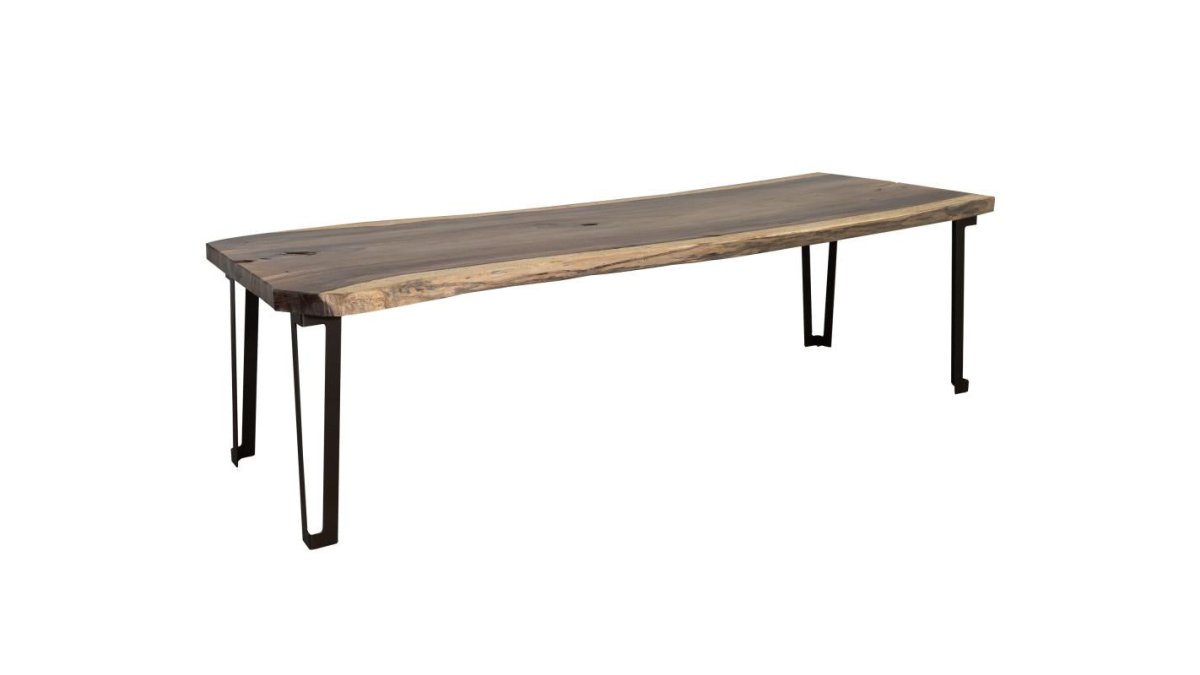
The Raramuri Live-Edge Copper-Epoxy Dining Table pairs a live-edge top with copper-toned epoxy detail that follows the wood's movement.

Live Edge Dining Table Sizes and Seating Capacity
Sizing a slab table is harder than sizing a standard one because live edges vary in width and the usable seating length changes along the top.
Natural Parota 95″ Live-Edge Dining Table →
Seating math. Most dining chairs need about 24 inches of table edge per person for comfortable elbow room; 30 inches is generous, and 20 inches is tight but workable for occasional seating.
| Table Length | Comfortable Seats (24 in/person) | Generous Seats (30 in/person) | Typical Use |
|---|---|---|---|
| 60 in | 2-3 per side, 4-6 total | 2 per side, 4 total | Small dining nook or kitchen |
| 72 in | 3 per side, 6 total | 2-3 per side, 4-6 total | Standard dining room |
| 80 in | 3 per side, 6 total | 3 per side, 6 total | Family dining |
| 95 in | 4 per side, 8 total | 3 per side, 6 total | Larger dining room |
| 100 in | 4 per side, 8 total | 3-4 per side, 6-8 total | Entertaining |
| 108 in and up | 4-5 per side, 8-10 total | 4 per side, 8 total | Formal or large gatherings |
Width and depth. A standard dining table is about 36-40 inches wide. Slab tables often run wider, sometimes 40-48 inches, which improves centerpiece space and comfort but eats into room clearance.
Room clearance. Leave at least 36 inches between the table edge and walls or furniture so chairs can pull out and people can walk behind seated guests. In tight rooms, 30 inches is the minimum for chair pull-out, but traffic behind seated diners becomes awkward.
Height and chair fit. Most dining tables sit 28-32 inches high at the top, with 30 inches the common standard. Allow 12 inches between the tabletop underside and the seat for legroom, and confirm your chair seat height (typically 18-19 inches for dining chairs) before ordering.
Our current size options include:
| Table | Length | Width | Standard Seating |
|---|---|---|---|
| Natural Parota 95" Live-Edge Dining Table | 95 in | Varies with slab | Roughly 6 to 8 |
| Sparks Ridge Canyon Dining Table | 80 in or 100 in standard | Approx. 38-40 in | Roughly 6 to 8 (80 in) or 8 to 10 (100 in) |
Custom Sparks Ridge lengths from 60 to 79 inches or 81 to 99 inches are available, and custom orders take approximately 3 to 4 weeks.
Measure your room, decide how many people you seat regularly, and choose the smallest table that meets that need with 36 inches of clearance. That approach keeps the table proportionate to the room and comfortable in daily use.
Wood Slab Table Base Styles: Industrial, Trestle and Underframe
The base affects both the look and the stability of the table. Industrial bases use steel or heavy frames for a strong, modern profile. Trestle bases place a crossbar between two supports, which opens up legroom at each end. Underframe bases attach beneath the top and leave the edges visible.
The Forge and Natural Parota tables pair their tops with industrial-style bases, while the Sparks Ridge features acacia wood with a live edge.
Choosing Your Wood Slab Dining Table at Mt. Modern
Start by deciding what matters most: grain character, size, base style or budget. Then compare two or three options side by side, looking at species, dimensions and construction method.
Current prices range from $1,147.00 for the Sparks Ridge Canyon Dining Table to $2,967.00 for the Forge Live-Edge Parota Dining Table. Our Arizona delivery is $199 flat rate per order, including in-home delivery, placement in your room of choice, and assembly when required. Free pickup is available in Cottonwood or Show Low.
Browse our full range of dining tables to compare sizes and finishes in one place. When you are ready to commit, shop the collection, ask about custom sizing, and confirm delivery options before you order.
Frequently Asked Questions
What is a wood slab dining table?
A wood slab dining table uses a single thick plank of solid hardwood as its top, usually cut from a large log and finished with the natural edge left intact or squared off. Because the top is one piece or a bookmatched set of pieces, the grain runs continuously and creates a focal point that mass-produced tables rarely match. Mt. Modern's live-edge dining tables include parota and acacia pieces, with prices starting at $1,147.00 for the Sparks Ridge and $2,653.00 for the 95-inch Natural Parota.
What is the difference between a live edge and a regular wood slab table?
A live-edge table keeps the tree's original bark-side outline, so the edges follow the natural curve of the log. A regular slab table has its edges trimmed straight for a cleaner, more uniform silhouette. Both can be solid wood. Live-edge pieces suit rustic or organic interiors, while squared slabs fit more formal or minimalist rooms. Each Mt. Modern piece is shaped by its own wood, so the edge profile varies from table to table.
How do I choose the right size wood slab dining table?
Allow about 36 to 42 inches of width per seat, measured along the table's length, and leave at least 36 inches of clearance behind each chair so people can sit and stand comfortably. For a six-person table, a length of roughly 70 to 80 inches works in most rooms. Mt. Modern's Sparks Ridge comes in standard 80-inch and 100-inch lengths, and custom lengths from 60 to 79 inches or 81 to 99 inches, typically ready in 3 to 4 weeks.
Which wood is best for a slab dining table?
Hardwoods such as walnut, oak and maple are common choices because they are dense and resist dents. Parota, a tropical hardwood, is valued for its dramatic grain and tonal shifts, which is why Mt. Modern's Natural Parota, Forge, Riverwood and Raramuri tables use it. Acacia is a solid, durable wood with strong natural markings and is used in the Sparks Ridge table. Choose based on grain look, budget and how much daily wear the table will take.
