

Last Updated: November 8, 2026
Quick Summary
Locally made furniture is worth buying when you value how a piece is built over low price, since it offers inspectable finishes and a reachable maker. Quality depends on joinery, solid wood, kiln drying, and finish rather than location alone.
- Check joinery first, such as mortise-and-tenon joints that lock pieces together mechanically.
- Look for solid wood with visible, consistent grain rather than veneer or particleboard.
- Ask whether the wood was kiln dried, since drying affects how stable a piece stays.
- Compare total cost over the years you plan to own the piece, not just the sticker price.
- Ask a maker which steps happen in-house to confirm the piece is truly made locally.
Table of Contents
- Why Locally Made Furniture Appeals to Arizona Homeowners
- How to Tell If Furniture Is Good Quality
- Locally Made Furniture vs. Mass-Produced Furniture
- Materials, Finishes, and Indoor Air Quality
- Questions to Ask a Furniture Maker Before You Buy
- Buying Furniture Online vs. In Store
- When Local Buying Isn't the Best Fit
- Choosing a Local Live-Edge Table for Your Home
- Frequently Asked Questions
Why Locally Made Furniture Appeals to Arizona Homeowners
Local furniture is worth buying when you care more about how a piece is made than about how cheaply it arrives. Arizona homeowners often weigh that trade-off when choosing between a live-edge table and a catalog option that costs far less. This guide walks through the real differences, the trade-offs, and the questions that help you decide.
Most of the appeal comes down to three things: a piece made close to home, a finish you can inspect in person, and a maker you can actually reach. Buyers who furnish vacation homes in mountain communities often add a fourth reason, which is wanting furniture that reflects the region's natural materials.
The catch is that "local" does not automatically mean "better." A piece can be made nearby and still be poorly built, and a distant maker can produce excellent work. The sections below focus on what to check, not just where a piece comes from.
How to Tell If Furniture Is Good Quality
Good furniture quality shows up in the joints, the wood, and the finish. Start by looking at how the parts connect. Mortise-and-tenon joinery, the kind used in our Mezquite II 87" Dining Table, locks pieces together mechanically.
Next, check the wood itself. Solid wood with visible, consistent grain usually signals a more substantial piece than veneer or particleboard. Ask whether the wood was kiln dried, since drying affects how stable a piece stays as humidity shifts.
Finally, examine the finish. A translucent, multi-step lacquer lets the grain show through while protecting the surface. Run your hand across the top and look for even coverage with no bubbling or tacky spots.
The article's quality checks come down to three areas you can assess yourself:
| Check | What to look for | Why it matters |
|---|---|---|
| Joinery | Mortise-and-tenon joints | Locks pieces together mechanically |
| Wood | Solid wood with visible, consistent grain | Signals a more substantial piece than veneer or particleboard |
| Drying | Kiln-dried wood | Affects how stable the piece stays as humidity shifts |
| Finish | Translucent, multi-step lacquer | Shows the grain while protecting the surface |
| Surface | Even coverage, no bubbling or tacky spots | Confirms a well-applied finish |
Locally Made Furniture vs. Mass-Produced Furniture
Mass-produced furniture is built for consistency and price. Locally made furniture is built for individual character and, often, a direct relationship with the maker. Neither is automatically superior, but the differences are real.
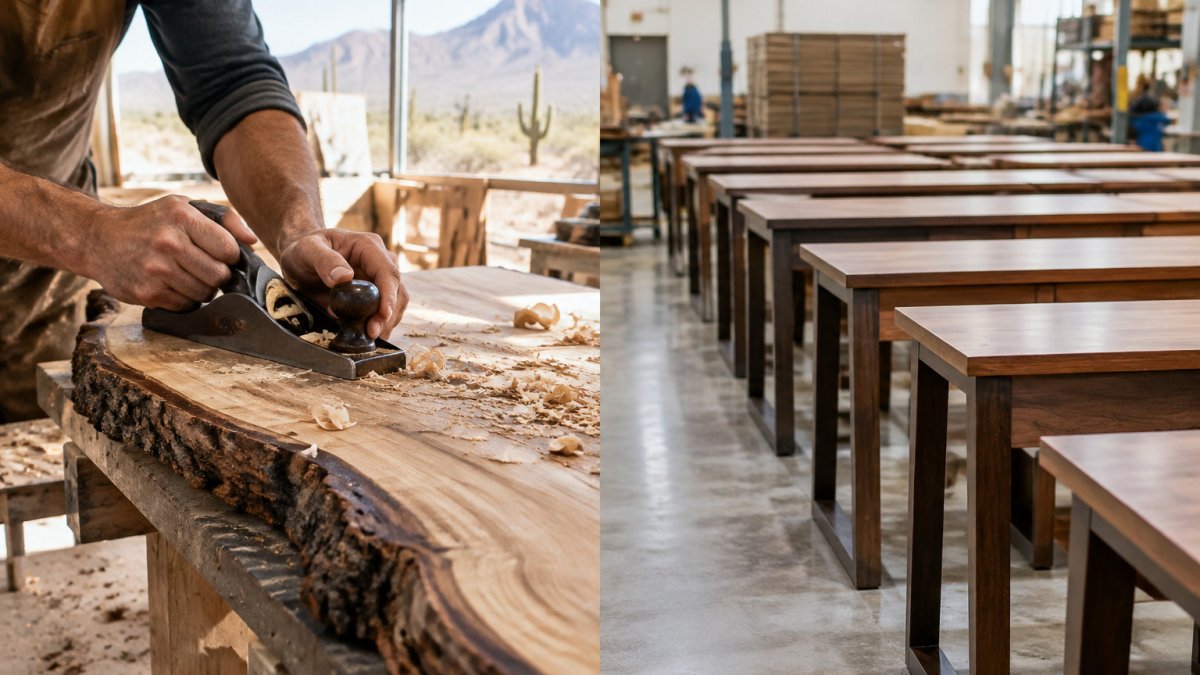
Mass-produced pieces are often identical across units, which is useful when you need matching sets. For a closer look at how handcrafted live-edge pieces differ from mass-produced versions, see how authentic live-edge pieces differ. Handcrafted live-edge pieces vary in edge, grain, and color, which many buyers value. That same variation means you need to see the piece before you commit.
Cost and lifespan also differ. Well-built pieces often cost more upfront, so compare total cost over the years you plan to own the piece rather than just the sticker price. Compare total cost over the years you plan to own it, not just the sticker price.
Materials, Finishes, and Indoor Air Quality
Materials and finishes affect how a piece wears, how it ages, and what it may release into the air inside your home. Most buyers stop at "solid wood," but the useful comparisons are more specific.
Wood species and hardness. Hardness is usually reported on the Janka scale, which measures the force needed to embed a steel ball into the wood. Higher numbers resist dents better. As a rough reference, black walnut and hard maple sit well above softer species like pine or aspen.
Solid wood vs. veneer vs. engineered core. Solid wood means the top is one species through its thickness. Veneer is a thin slice of wood over a core, often plywood or MDF. Veneer is not automatically bad; high-quality veneer over a stable plywood core can resist warping better than a wide solid slab.
Adhesives and binders. Plywood, MDF, and particleboard are held together with adhesives. Some adhesives are formulated to have lower formaldehyde emissions than others. EPA's TSCA Title VI rule (the EPA).
Finish systems. A finish is not one product but a system: stain, sealer, and topcoat. Lacquer, polyurethane, hardwax oil, and conversion varnish behave differently. Ask how many coats are applied, whether the finish is water-based or solvent-based, and how long it cures before delivery.
Certifications and what they mean. Look for specific claims rather than logos. GREENGUARD and GREENGUARD Gold are third-party programs that test for volatile organic compound emissions from finished products. FSC certification addresses forest management, not indoor air. A piece can be FSC-certified and still use a high-emitting adhesive, or low-emitting and not FSC-certified.
Kiln drying and moisture content. Properly dried lumber is less likely to warp, crack, or shift once it reaches a heated or air-conditioned home. To understand why kiln-dried wood matters for stability, read is kiln dried wood better for furniture.
A practical comparison. When you compare two pieces, line up the same five facts: species and Janka rating, core material, adhesive or panel emission standard, finish system and cure time, and moisture content at assembly. A maker who can answer all five is giving you something to evaluate. A maker who cannot is asking you to trust a label.
Watch out: "Low-VOC" and "non-toxic" are marketing terms without a single legal definition for furniture. For guidance on keeping a mesquite finish in good condition over time, see mesquite furniture care. Ask for the specific standard, test report, or product data sheet rather than accepting the phrase at face value.
Questions to Ask a Furniture Maker Before You Buy
"Local" is a claim, not a certification. For a practical guide to confirming a piece is authentic and handcrafted, see how to identify authentic handcrafted mesquite.
Where the materials come from. Ask which species are used and where the lumber was milled or purchased. A maker who buys from a regional mill can often name it.
Where each step happens. Production usually breaks into design, milling, joinery, assembly, finishing, and upholstery. Ask which of those steps happen in the maker's own shop and which are subcontracted.
How the joints are built. Ask whether the piece uses mortise-and-tenon, dovetail, dowel, or screw-and-bracket construction, and where each appears. A dining table may use mortise-and-tenon in the base and screws in a removable top, which is normal.
Finish and cure. Ask what finish system is applied, how many coats, and how long the piece cures before it ships. Ask whether the finish is water-based or solvent-based and whether a product data sheet is available.
Lead time and deposit terms. Custom production is not instant. Ask for the current lead time in weeks, not "a few weeks," and ask what triggers the clock: order date, deposit date, or material arrival.
Inspection, delivery, and damage. Ask whether you can inspect the piece before paying the balance, and what the process is if it arrives damaged.
Warranty and repair. Ask what the warranty covers, how long it lasts, and whether it covers finish and structural failure separately. Ask whether the maker does repairs in-house and what a refinish costs after the warranty ends.
Customization limits. Ask what can be changed (length, height, edge profile, finish color) and what cannot. Ask whether a custom size changes the lead time or the price, and whether custom orders are returnable.
References and shop access. Ask whether you can visit the shop or see the piece in person before delivery. Ask for references from past customers with similar pieces. A maker who welcomes a shop visit is usually confident in what you will see.
Watch out: a maker who answers "local" to every sourcing question without naming a mill, a species, or a step is giving you a marketing answer, not a production answer.
Buying Furniture Online vs. In Store
Buying online offers selection, convenience, and often competitive pricing. The downside is that you cannot touch the wood, check the finish, or judge scale in your room before the piece arrives. Live-edge furniture is especially hard to judge from photos because grain and edge shape change dramatically between pieces.
Buying in person lets you inspect the finish, feel the edge, and test the proportions against your space. For a large dining table, that inspection can save a costly return. Buyers in the Cottonwood and Show Low areas can pick up in person, which lets them inspect before taking the piece home.
If you buy online, look for clear return terms, detailed dimensions, and close-up photos of the actual wood. Ask the seller for measurements that match your room before you order.
When Local Buying Isn't the Best Fit
Local buying is not the right choice for everyone. If you need a set of matching chairs in two weeks, a stock piece from a large retailer may be a better fit. If you want a perfectly uniform finish across a dozen pieces, mass production is more consistent.
Budget also matters. Handcrafted furniture usually costs more, and that premium is not always justified for a rental, a short-term home, or a room you plan to redecorate soon. A simpler piece may serve you better in those cases.
Buying local can make sense when the piece is central to the room, you expect to keep it for years, and you value its individual character. For everything else, a less expensive option may be the smarter choice.
Choosing a Local Live-Edge Table for Your Home
Start with size. Measure the room and allow about 36 inches of clearance around the table for chairs and walking space. Our Sparks Ridge Canyon Dining Table, priced at $1,147.00, comes in standard 80-inch and 100-inch lengths, and custom lengths are available for a more precise fit. Custom orders generally take about 3 to 4 weeks, so plan ahead.
If you want a larger statement piece, the Natural Parota 95" Live-Edge Dining Table at $2,653.00 suits a substantial dining space. For a modern industrial look, the Forge Live-Edge Parota Dining Table at $2,967.00 is built to anchor a room. Arizona-wide delivery is $199 per order, and free pickup is available in Cottonwood or Show Low.
Look at the edge, the grain, and the finish in person if you can. Because every live edge is different, the table you receive will have its own character.
Get a table that will anchor your room for years. Visit Mt. Modern to explore live-edge dining tables made for Arizona homes.
Frequently Asked Questions
What are the advantages of buying locally made furniture?
Locally made furniture usually means you can see the workshop, ask who built the piece, and learn what wood and finishes were used. Shorter delivery distances reduce transportation emissions, and the purchase supports local workers and businesses. Quality varies by maker, so the real advantage comes from verifying construction, materials, and the maker's willingness to answer detailed questions before you pay.
Is it better to buy furniture online or in a store?
Buying online offers wider selection and easy comparison, but you cannot touch the wood grain, test the seating height, or inspect joinery before delivery. In-store or showroom visits let you see finishes under real light. Many shoppers do both: research online, then confirm the finish, size, and fit in person. Ask about return and inspection policies for either channel.
How can you tell if locally made furniture is good quality?
Look at joinery such as mortise-and-tenon or dovetail construction, check for even finish coverage, and examine how the wood is dried and sealed. Ask the maker about lead times, warranty terms, and repair options. A reputable maker will explain the materials and process without hesitation. Mt. Modern pieces such as the Mezquite II 87" Dining Table use mortise-and-tenon construction and are priced from $1,097.00.
Can you customize furniture made by a local furniture maker?
Many local makers offer custom sizing, finish options, or made-to-order lengths. Mt. Modern's Sparks Ridge Canyon Dining Table, for example, can be ordered in custom lengths of 60-79 inches or 81-99 inches, with about 3-4 weeks needed for production and full payment due when the order is placed. Confirm timelines and terms before committing.
Dining table prices from Mt. Modern
